Saturday, November 27, 2010

Moods of the sky ...

One thing I love about where I live is that there is a field behind the house, which is near the top of a hill. There is a great view to the west, which is a contrast to the situation of most houses in this area. Most houses either look onto a patch of woods, or into another house and yard the next street over. Over time, the sky has many different "moods".


Dramatic and contrasting:


Somber and gray, but with a bit of a lighter side:

Bright and cheerful:


A flash of light through the gloom:


Murky and mysterious:


A calm but colorful finale:

Friday, November 26, 2010

Turkeys and the "Columbian exchange"

When the group of English colonists commonly known as Pilgrims crossed the Atlantic, they brought domestic turkeys with them. When they reached what is now Massachusetts, they found wild birds of the same species living there. At the festival of the first Thanksgiving, they may well have eaten either, or both, wild and domestic turkeys.

The turkey is a native of North America only. Given this, how could European settlers have brought turkeys from Europe to North America? The answer is that turkeys had already been brought from North America to Europe in the sixteenth century. The Pilgrims were already used to eating a distinctly "American" food long before they left England or the Netherlands to come to Massachusetts.

There are several different subspecies or varieties of wild turkey in North America. The southernmost of these subspecies lives in central Mexico. It was the only variety that was domesticated. When the Spanish overran the great Mexica (Aztec) empire in Mexico, they learned about the local foods. Apparently they liked turkeys enough to bring them back to Spain not long after the conquest of Mexico. From Spain, they spread through many other parts of Europe by the end of the sixteenth century, including England.

When the bird reached England in the late sixteenth century, there was a problem with names. The Spanish referred to the birds by a version of their native Mexican name. Hardly any of the English, on the other hand, knew exactly where these birds came from. At that time, the Ottoman or Turkish Empire controlled much of eastern Europe, the Middle East, and North Africa, and was seen as strange and exotic by most people in western Europe. People tended to assume that most strange things, including strange animals and plants, came from Turkey. The large, meaty, but odd new bird became known as the "Turkey bird", because so many people assumed that it came from the empire of the Turks.

The spread of the domestic turkey from Mexico to Europe and then back across the Atlantic to more northern regions of North America is just one small example of a massive movement of domesticated and non-domesticated plants and animals known as the "Columbian exchange". It gets its name from the fact that it was the voyages of Christopher Columbus that started the exchange by encouraging further exploration, conquest, and colonization of new lands by Europeans.

Among other things, Europeans brought wheat, grapes, barley, oats, apples, peaches, oranges, pears, peas, rice, coffee, tea, sugarcane, pigs, sheep, cows, horses, honeybees, and a bunch of diseases from the "Old World"continents of Europe, Africa, and Asia, to the lands they considered a "New World". In return, they took, among other things, corn/maize, potatoes, chili peppers, beans, squash, sweet potatoes, cacao/chocolate, tomatoes, and pineapples back to not only Europe but to other parts of the "Old World". (Turkeys seem to have been the only domesticated animal taken in significant numbers from either American continent to the "Old World".

By doing this, they drastically changed the world's economy. Potatoes in northern and western Europe produced larger quantities of food on the same amount of land than traditional crops like wheat. This eventually led to a great increase of population in northern and western Europe, which probably helped make the industrial revolution possible creating a large number of former peasants who could not find work in rural areas and so came to early factories looking for work.

Corn/maize had little impact in northern or western Europe, but it became a major crop in parts of southern and eastern Europe. Its greatest impact, though, was probably in tropical Africa. Corn varieties that came from wet tropical regions of North and South America grew well in wet tropical areas of Africa, and as the potatoes did in Europe, they produced more food on the same amount of land than traditional local crops like yams. As in Europe, the new crops helped support a major increase in population, but instead of the Industrial Revolution, the extra population in Africa had a much worse fate. All of those extra people probably helped encourage various kingdoms and tribes in western and central Africa to go to war more often, and capture people from enemy kingdoms and tribes as slaves. Many of these slaves were sold to European slave traders, who took them to plantations in the American continents and the Caribbean.

So, just two crops going from the Americas to the "Old World" probably helped create both the African Slave Trade and the Industrial Revolution. The effects of the "Columbian Exchange" certainly went well beyond what was eaten at the first Thanksgiving!

Sunday, November 14, 2010

Plant and garden pics from this year

Lilacs blooming in front of the house in May


Pyrethrum or Painted Daisies in bloom, May
(species possibly Chrysanthemum coccineum also called
Tanacetum coccineum)


Unfortunately blurred closeup of a flower whose name escapes me at the moment,
taken in May.


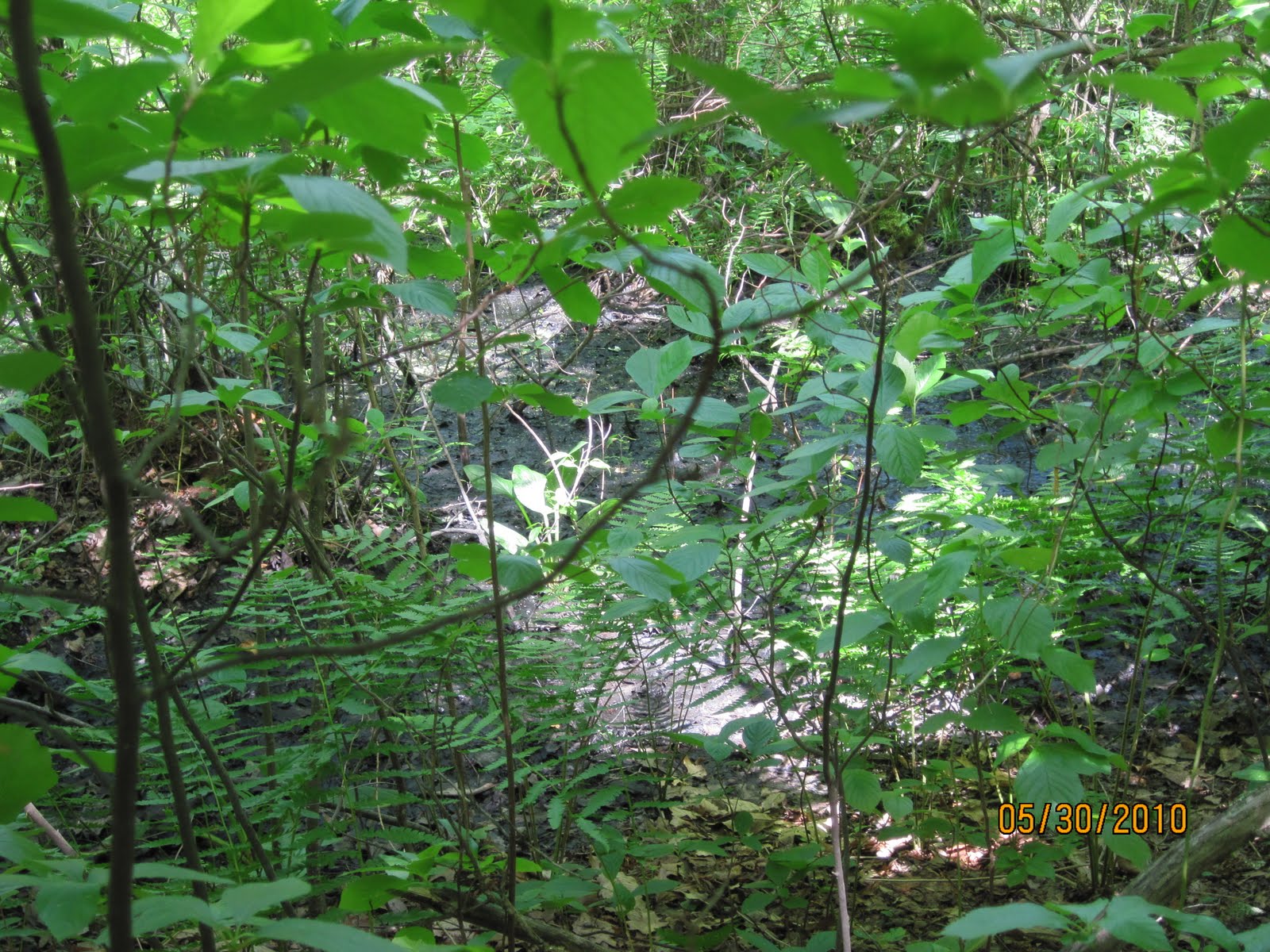
Edge of a swamp area near where I live.


Emerging catkins (long clumps of tiny flowers) and leaves on a
white oak (Quercus alba), taken in May


Clusters of small white flowers on a
black cherry (Prunus serotina), taken in May.

Peonies in bloom, taken in June


Sunset from the back yard, taken in June

Saturday, November 6, 2010

On a different note, I looking at some of my photos taken during the last 2 or 3 months, and found a few that might be worthy of posting:


A big moth of some kind on a screen door to the back porch. It was about 1.5 inches wide,
with a distinctive color pattern.


A small tree growing alongside the sidewalk along the main street in my town.
I believe that it might be an American Chestnut growing back from
the remains of a much older one - the leaves seem to be the right size, shape
and configuration.


An Eastern Hemlock (Tsuga canadensis) in the front yard. At about 20 years old,
it has gotten a little too tall to easily fit into a picture taken from near the house.


A fall-flowering wildflower - I'm not sure which one, but it was pretty.
Note the 3-leaved menace, poison ivy, sneaking into the picture to the
upper left. By now, they've both probably gone dormant for the winter.


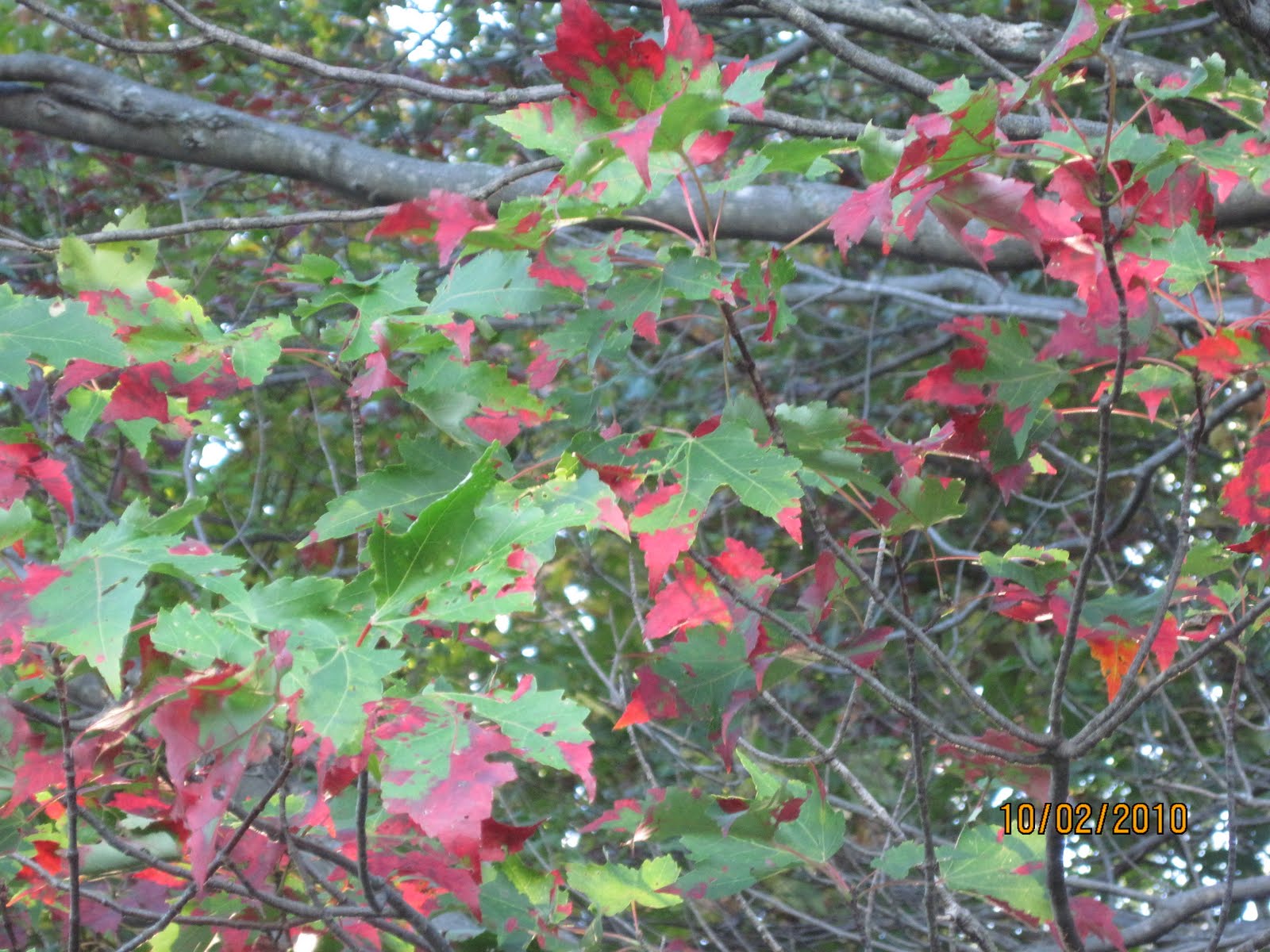
Maple trees showing patches of color a little more than a month ago.
They might be either Sugar maple (Acer saccharum) or Red maple (Acer rubrum)-
I can't tell from this picture. By now, they've almost certainly lost close to 100%
of their leaves.


A single Red maple leaf lying on a juniper bush in the backyard, looking kind of like
the Canadian flag would look of the Canadian flag had a background
of green juniper foliage, and a differently shaped maple leaf with dew on it.


Sometimes individual maple leaves get patches of color while the rest is still green.
This might be a Silver maple based on the shape of the leaves, which look more
deeply lobed than either Sugar or Red maple leaves.


White oak (Quercus alba) fall foliage, from a small branch that broke off a white oak next door.
Oaks usually don't get showy fall foliage, but white oaks sometimes get
this sort of burgundy-like color.


Virginia creeper (Parthenocissus quinquefolia), a native vine related to wild grapes,
often gets bright red foliate in the early autumn. The neighboring invasive
Oriental bittersweet (Celastrus orbiculatus) to either side of it remains green later
into the fall, and then turns yellow briefly before dropping off.


Ginkgo biloba is a unique species of tree that is the last survivor of what was once a widespread group of plants. It is also a popular ornamental tree in this area, since it can grow
in heavily built-up areas, has a nice, symmetrical form, and a unique shape of leaf.
Ginkgo has separate male and female trees. The male trees are more popular to plant because
they do not produce any fruit - ginkgo fruit is edible but gives of an unpleasant smell.
I had assumed that this was a male tree until the fall when I saw what were quite clearly fruits hanging in the branches. I didn't notice any unpleasant smell, either. Either I was just
lucky or I'm unusually insensitive to the smell.
Ginkgo leaves turn a nice bright golden yellow later in the fall, and then drop off quickly.
One day last week I noticed that this particular tree was almost bare, and all the fallen leaves
formed a nice bright yellow carpet on the ground. I'm not sure what happened to the fruit.


Wednesday, November 3, 2010

Ups and downs

WARNING: Introspective, depressing, somewhat whiny post ahead. Please ignore if you don't want to read that kind of thing.


So again I took a long "vacation" away from blogging. The problem I have is that with my tendency to obsessiveness, once I get in the habit of checking this thing daily, I spend more and more of my time going around reading various peoples' blogs and occasionally get into an argument just for the heck of it. Clearly, this is unhealthy, so I step away. Unfortunately, I have a couple of other sites that I go to and do basically the same thing at when I'm not here. Why would any person with any intelligence or self-respect waste their time this way? In my case, at least, it's because bouncing around the internet getting involved in the occasional pointless argument is vastly more enjoyable than my other OCD-related activities. My other most common OCD related activities are:

1. Frequently worrying that I've run over animals, and sometimes people, in my car. This obsession has progressed to the point where I no longer totally trust my own senses, and worry that I've hit things even when I have no evidence for it at all, not even a bump.

2. Experiencing wild mood swings in which I alternately repeat certain abstract thoughts that make me happy, and think of reasons why those thoughts are nonsense and why I really should not be happy.

3. Generally coming up with reasons why I am a poor excuse for a human being who has utterly wasted his entire life.

I realize that these descriptions are incredibly vague, but describing the details of my thought process would take a lot more room and, more importantly, would be largely nonsense to anybody else. Still, these brief summaries should probably give a clue as to why wasting time on the internet is actually the most enjoyable aspect of my OCD. Of course, excessive internet usage is not the only unhealthy activity that I engage in as a way of trying to get relief from my OCD. I've also been eating lots of junk food and gaining some weight back. It sucks, but if you're a stress eater like I am, a jumbo box with a pound of Cheez-Its or Doritos or popcorn is surprisingly effective at calming the brain down after a bad day of recurring negative obsessions.

Anyway, on the brighter side of things, I have finally got my butt moving enough to start looking at houses. I went looking at a half dozen with my realtor last Saturday, and will go looking at some more this Saturday if I can figure out which ones on the list I want to look at by tomorrow (well, later today, actually). It's unfortunate that what should be my highest priority, along with other priorities like work, finances, life, etc., are fighting an uphill battle with my various facets of my OCD for attention in my brain - but that's the story of much of my life. After a meeting with my psychiatrist today, we agreed that it would be a good idea to look for both a support group and new prescription. Hopefully this will work well.

Saturday, September 18, 2010

Late summer flowers

After the previous post, here's something lighter ....

My gardens are rich in plants that flower in spring and early summer, while there are a lot fewer flowers in the middle and later part of the growing season. I should have changed this, but I'm ultra-conservative in my gardening - if an existing plant is healthy and produces lots of flowers, I hate the idea of removing it just to put in something different.

Still, the later summer is not completely devoid of flowers and other interesting features. Here are a few:

In spite of its name, the Blackberry lily (Belamcanda chinensis) is closely related to irises rather than lilies. Its foliage consists of a fan-shaped pattern of long, straplike, pointed leaves, just like an iris, but the flowers look more like small orange lilies (hence the name). It's not a very showy plant, but I think it looks nice in a modest sort of way.

These flowered unusually early.

The small but colorful flowers only last for a single day, much like those of a Hemerocallis or daylily. Again like a daylily, a single plant will usually produce at least several days' worth of flowers.

Why is it called a blackberry lily? To understand this, you have to wait a little while until the seed pods start to burst open and reveal the clumps of seeds:

Each clump of small, round, black, shiny seeds looks remarkably similar to a blackberry. The resemblance is an illusion - each seed is separate, and they are hard and inedible. They do look pretty, though.

The blackberry lily is native to parts of China, and was brought to the US as an ornamental garden plant. One of the first people to grow them in the USA was supposedly Thomas Jefferson. This is especially significant because all of the blackberry lilies in my gardens are descended from a few seeds that my mother got at Monticello (where they are still grown in the gardens) about 12 years ago. The plant is a prolific self-seeder, and now grows in a number of different parts of the garden.


"Autumn joy" sedum is an extremely common, extremely hardy plant that flowers from late summer through late autumn. It is also a magnet for a variety of different insects. It started to attract bumblebees before the flowers were property opened:


Once the flowers open completely, they are a reddish-pink color.
As time goes on, they gradually turn more of a brick-red color, and then turn to a reddish brown as they go to seed later in the autumn. They last that way throughout the whole winter.


The Chinese lantern plant (Physalis alkekengi) has small greenish flowers that are difficult to see, but in late summer it develops bright orange coverings over its fruits - sort of a like a loose, natural "wrapping paper". These really stand out and make the plant worthwhile for adding color to the garden.
The plant's other outstanding feature is its ability to spread through underground runners and pop up in completely different places each year. It's actually pretty "weedy", and it would get pulled out quickly if it weren't for the nice orange "lanterns".


Some of the color in the gardens this time of year does not come from deliberately planted garden plants. This is the time of year when the goldenrods (members of the genus Solidago)
are in bloom. These are either weeds or wildflowers depending on one's perspective. Some people associate them with hay fever and allergies, but in fact they don't cause allergies. They just happen to bloom at the same time as ragweed, which does cause allergies, but has very inconspicuous flowers. For hundreds of years, people have been hit with allergies at the same time of the year that goldenrod has been the most obvious, colorful wildflower in bloom, so people naturally associated goldenrod with the allergies.

Falsely accused

There are lots of species of goldenrod, and I'm not enough of an expert to tell the difference between most of them.
One of the "golden rods" close up


Finally, in the category of "not especially pretty, but interesting", I put some of the grasses that pop up in the gardens. A lot of the weeds in my garden are grasses, and these fall into 2 categories. First, there are the usual grasses - the lawn grass encroaching into the flower beds, and the usual crabgrass. Second, there are the types of grasses that you don't see as often in a suburban yard. I suspect that most of these come from the field right behind out house, where they used to graze sheep and cattle but now let the grass grow and cut and bale it it twice each summer for hay.

Friday, September 17, 2010

Emotional exhaustion


I don't write about my emotional struggles very often. When I do write about them, I don't do it very well. It's not something that I'm used to doing. It often seems pointless because the specific things that get me upset are often so odd and divorced from the everyday world that putting them in writing just makes me look like a complete moron. Lately, though, I've been going through a pretty difficult period. It's one of the reasons why I haven't been reading or posting much lately. Frequent mood swings and going back and forth in my mind about questions like whether I have good reasons to be happy and whether my emotions are justified or not is just something that gets exhausting after a while. It takes a lot of time and effort, and my productivity in all of the normal, external parts of my life suffers for it. It also leads to a lot of erratic behavior, and makes me pull even further into myself than normal.


I read the blogs of a couple of people who are very eloquent about describing their emotional struggles and the reasons behind them. I don't have any such ability. All I can say is that when I'm in a certain mood, I can find an almost limitless number of reasons to hate myself.