Showing posts with label history. Show all posts

Monday, December 27, 2010

A unique view of early New England, part 1

 One of the most detailed accounts of the geography, climate, weather, plants, and animals of New England in the 17th century did not come from a person who lived there, but from an English traveller named John Josselyn.  A moderately wealthy man with connections to the original non-Puritan rulers of Maine, he travelled to the Massachusetts Bay colony and Maine as a fairly young man in the 1630s, and again as an older man in the 1660s (by which time Maine had become part of Massachusetts Bay).  He wrote two books, one called New England's Rarities, discovered in Birds, Beasts, Fishes, Serpents, and Plants of that Country, and the other one called An Account of Two Voyages to New-England.  These works, especially An Account of Two Voyages to New-England, are written in a meandering, sometimes almost stream-of-consciousness style.  An Account of Two Voyages mixes all sorts of information on New England with accounts of some of his own personal experiences and his opinions about various subjects ranging from geography meteorology to astronomy to mining to law and government.  In spite of his tendency to go off on tangents in his writing, it has a lot of interesting information about the condition of New England in the first generations of English settlement, and an interesting perspective on what New England looked like to an early traveler from "Old" England.


"The shore is rocky, with high cliffs, having a multitude of considerable harbors; many of which are capacious enough for a navy of 500 sail, ... the country within rocky and mountainous, full of tall wood, one stately mountain there is surmounting the rest, about four score mile from the Sea ... between the mountains are many ample rich and pregnant valleys as ever eye beheld, beset on each side with variety of goodly trees, the grass man-high unmowed, uneaten and uselessly withering; within these valleys are spacious lakes or ponds well stored with fish and beavers ... manifesting the goodness of the soil which is black, red-clay, gravel, sand, loam, and very deep in some places, as in the valleys and swamps, which are low grounds and bottoms infinitely thick set with trees and bushes of all sorts ... others having no other shrub or tree growing, but spruce, under the shades whereof you may freely walk two or three mile together; being goodly large trees, and convenient for masts and sail-yards.  The whole country produces springs in abundance replenished with excellent waters, having all the properties ascribed to the best in the world." - John Josselyn, An Account of Two Voyages to New-England, p. 37-38.

The description of a rocky coast and spruce forests probably reflects the time he spent in what is now Maine more than what is now Massachusetts - Josselyn doesn't always distinguish one part of New England from another when evaluating it.  It is clear that he was impressed by the abundance of both large trees and the beaver and fish along and in the lakes and rivers.  These resources that later became very depleted from intense use - beaver were almost wiped out in much of New England by the 18th century, which changed the whole landscape, greatly reducing the number of small lakes, ponds, and swamps, many of which had been created by beaver dams.

   It is also clear that there was plenty of fresh water springs in many places - always an important factor for early settlers.  The description of the richness of the soil is somewhat optimistic.  There is indeed good black loam in some parts of New England, but it is often quite thin, and in the more hilly areas there is often barely more than an inch of good topsoil before one hits clay or sand or bedrock underneath it.


"The mountains and rocky hills are richly furnished with mines of lead, silver, copper, tin, and divers sorts of minerals, branching out even to their summits, where in small crannies you may meet with threads of perfect silver; yet have the English no maw to open any of them, whether out of ignorance or fear of bringing a foreign enemy upon them ... The stones in the country are for the most mettle-stone, free-stone, pebble, slate, none that will run to lime, of which they have great want, of the slate you may make tables easy to be split to the thickness of an inch, or thicker if you please, and long enough for a dozen men to sit at.  Precious stones there are too ..."- John Josselyn, An Account of Two Voyages to New-England, p. 38-39.

Josselyn is apparently falling into the trap that many earlier explorers had fallen into - assuming that every part of the Americas was full of precious metals.  Although there were small amounts of metal ore in a few places, there were no large veins of metal ore anywhere in New England.  The reason that the English settlers weren't setting up big mines is that there wasn't very much to mine in the first place.  There were later a variety of stone quarries and smaller mines, but although New England became well-known for its rockiness, most of that rock did not have anything valuable in it.

One accurate thing that he notes is that there is no limestone or chalk in most parts of New England, in contrast to many parts of England.  The lack of rocks that produce lime meant that they usually had to import lime from elsewhere, and it also led to the soil in most parts of New England being quite acidic, with no lime to make it alkaline.


"The climate is reasonably temperate, hotter in summer, and colder in winter than with us, agrees with our constitutions better than hotter climates, ..." - John Josselyn, An Account of Two Voyages to New-England, p. 39.

Here Josselyn nails the most fundamental difference between the continental climate of New England and the maritime climate of old England - the wider temperature extremes.  When early explorers briefly landed in places like New England or Nova Scotia or Quebec or New York in the summer, they usually assumed that the winters must be mild.  This was based on the warm summer temperatures and the fact that what later became the northeastern USA and southeastern Canada are at a lower latitude and closer to the equator than much of Europe (Boston is on almost the same latitude as Rome).  The first winters that Europeans spent in these areas were usually an unpleasant surprise.

The comment about the climate "agreeing with our constitutions better" than warmer climates may actually be referring to the relative lack of disease, because disease was widely thought to be caused by the effects of climate on the "constitution" of the body.  For the white settlers, New England was one of the healthiest climates in the world.  Diseases like smallpox existed, but were less common than in Europe, while warm-weather diseases like malaria were also rare.  For the American Indians, on the other hand, the disease environment was a disaster, with even the occasional introduced European disease running wild among a population with very little resistance.


"Mid-March their spring begins, in April they have rain and thunder; so again at Michaelmas [late September], about which season they have either before Michaelmas or after outrageous storms of wind and rain. ... Cold weather begins with the middle of November, the winters perpetually freezing, insomuch that their rivers and salt-bays are frozen over and passable for men, horse, oxen, and carts ... The north-west wind is the sharpest wind in the country.  In England most of the cold winds and weathers come from the sea, and those seats that are nearest the seacoasts in England are accounted unwholesome, but not so in New-England, for in the extremity of winter the north-east and south-wind coming from the sea produces warm weather, only the north-west-wind coming over land from the white mountains (which are always, except in August, covered with snow) is the cause of extreme cold weather, always accompanied with deep snows and bitter frosts, the snow for the most part four and six foot deep, which melting on the surfaces with the heat of the sun (for the most part shining out clearly every day) and freezing again in the night makes a crust upon the snow sufficient to bear a man walking with snow-shoes upon it.  And at this season the Indians go forth on hunting of deer and moose, twenty, thirty, forty miles up into the country.  Their summer is hot and dry proper for their Indian wheat [i.e., corn or maize] ; which thrives best in a hot and dry season, the sky for the most part summer and winter very clear and serene; if they see a little black cloud in the north-west, no bigger than a man may cover with his hat, they expect a following storm, the cloud in short time spreading round about the horizon accompanied with violent gusts of wind, rain, and many times lightning and terrible thunder." - John Josselyn, An Account of Two Voyages to New-England, p. 45-47.

If the winters Josselyn describes sound a little harsher than those in Massachusetts or southern Maine today, with saltwater harbors freezing over deeply and 4-6 feet of snow, this may be because many parts of North America and Europe really were colder 350 or so years ago.  This was the later part of what is sometimes called the "Little Ice Age", a period of somewhat colder than average weather that lasted from the 1400s through the early 1800s.  This was an era when the Thames River in England and the canals of the Netherlands froze over deeply enough most winters to walk and skate on - and that was in the relatively mild winters of western Europe.  In New England, average winter temperatures were considerably colder than average winter temperatures today - Massachusetts probably felt more like Maine, and Maine might have been almost as cold as central Quebec.

Other aspects of the weather that Josselyn describes are quite familiar to modern New Englanders - the rainstorms of spring and fall, the icy crust that forms over snow from freezing and thawing, and the sudden changeability of the weather, where a small dark cloud on the horizon often means a total change of weather very soon.

Sunday, December 5, 2010

Changes in local plants over time

Combining my interest in history with botany, I have sometimes wondered what my area looked like when the earliest Europeans arrived - especially the plants.  How were the plants different, and how were they similar?  Well, based on reports from native and European sources, and scientific analysis of old pollen and plant remains, one can make some guesses.


Apart from the obvious lack of modern cities, highways, roads, housing subdivisions, shopping malls, etc., etc., one of the most striking differences would have been in the characteristics of the forests themselves.  Much of the forest would have much larger trees than we are used to seeing in wooded areas today.  There were large areas of forest that had never been cleared at all, truly old-growth forests that would be full of widely-spaced trees with trunks that were 3, 4, 5, or even 6 feet in diameter at the base, and 10 to 20 feet in circumference, trees that had reached this size because they were several hundred years old.  There is very little forest like this left in New England today - almost every piece of land has been cleared or logged at least once in the last 300+ years.  Almost all wooded areas today are much younger overall, ranging from forests of numerous young saplings 10 or 15 years old to those with much larger, older trees, perhaps 100 years old, that look impressive in size but which are actually still skinny youngsters compared to the massive, several-century old trees that were fairly common when the first Europeans came.

Of course, not all of the land was covered with old-growth forest.  The American Indians in southern New England had been clearing land for agriculture for centuries, and there was quite a bit of second-growth forest in areas that they had once farmed but later left.   They also kept some hunting areas clear of woods for many generations by repeatedly setting small fires that would kill young trees but leave grasses and other non-woody plants to grow back.  Because of this controlled use of fire to create terrain more favorable for hunting, Europeans were sometimes surprised to find large open areas of fields, extending many miles, on land where they expected to find dense forest.  The use of fire extended to the old-growth forests themselves.  Small fires did no permanent damage to the older trees, but they helped to clear out vines and thorny shrubs and other undergrowth, which made tracking and chasing animals in the forests easier.  Again, early Europeans sometimes remarked on how open the forest floor was in the old-growth forests.  A man could easily ride on horseback along the forest floor, with little dense underbrush to impede him.  One early English explorer in Virginia noted that in some areas, the spaces between the big old trees were large enough that one could have driven a full carriage with its team of horses right between the trees with no trouble!  Not all of the wooded areas were this clear, however.  In areas where there were fewer animals to hunt, such as steeper hills and mountains, or areas with poor soil or areas just not frequented by many animals, the Indians didn't practice their forest management through controlled burning, and the underbrush was much thicker and took some effort to penetrate.

The majority of the types of trees most common in forests were the same as today, but their proportions were different.  Old growth forests, not surprisingly, tended to be dominated by the trees that had the longest lifespans, which usually meant various oaks, various pines, sugar maples, and beeches.  Trees that are common in the relatively young forests found today, such as red maple, black cherry, and birches, were a lot less common.  They would be found mainly in the second-growth patches where there had been Indian farms and towns, or major forest fires or storms had cleared an area of its old trees.  They were also often found in areas where the more dominant tree types would not grow, like swamps and steep, rocky hillsides.  One consequence of this was that the autumn foliage was probably not nearly as impressive, since the brightest colors - the reds and oranges and the most brilliant yellows - often come from maples, which were less common in the 17th century forests.

There was one tree that was quite common in these forests that is only occasionally seen anywhere today, and that was the American Chestnut.  They were once common enough that many New England towns have a "Chestnut Street" along with an "Oak Street", "Maple Street", "Elm Street", "Pine Street", but the Chestnut Blight fungal disease killed virtually all of them in the early 20th century, and the only thing that kept some of them alive was their tendency to re-sprout from the roots after the main part of the aboveground tree has died.  Elm trees have suffered a major blow from Dutch Elm disease at the same time, but they were not quite as common as Chestnuts before the diseases came, and Dutch Elm disease isn't quite as universally destructive as Chestnut Blight is.

Many of the other plants one could see at various times of the year would have been familiar to people today - wild grapevines and Virginia creeper climbing up trees, skunk cabbage poking through the ground in swamps before the snow is even gone, short-lived spring wildflowers blooming before the trees above them have grown their leaves in the early spring, milkweeds producing their seedpods full of seeds with feather-like tufts that allow the wind to catch them, goldenrods blooming in late summer, along with the much less welcome ragweed.  There would, however, have been some very familiar plants that would be missing.  Some of these missing plants wouldn't be missed very much, since they are notoriously invasive, fast spreading, and tough to kill.  There would have been no clumps of Japanese Knotweed, no bittersweet vines climbing up trees, no purple loosestrife forming dense swathes in wetlands.  Some less invasive, but very common weeds would also have been lacking.  The best known of these is probably the common dandelion.  Other common weeds seen today that would have been completely lacking at the time of the first Europeans would have been chenopodium, aka lamb's quarters or goosefoot, common plantain, shepherd's purse, and common mullein.  Some common wildflowers would have been lacking as well, including Queen Anne's lace, common or ox-eye daisies, Chicory, and Black-eyed Susans.  Almost all of these plants, whether considered weeds or wildflowers (or both), are originally from Europe and Asia, and were introduced to the eastern part of North America.  The one exception is the Black-eyed Susan, which is native to the prairies of the midwest and was not brought east of the Appalachians until the 19th century.

There is a lot more stuff that I could add, but the short version is that the forests and fields of Massachusetts would have looked considerably different from today in the 16th or early 17th century, even apart from the obvious and blatant changes like clearing of forests, creation of farms and villages and towns, and later cities, factories, highways, malls, etc.  Just the changes in how the forest was handled and used by the people living in the area, and the plants that were introduced, made major changes.  Of course, there were many other changes to the environment caused by changes in the animal life, but that is a story that I don't have time for right now ....

Friday, November 26, 2010

Turkeys and the "Columbian exchange"

When the group of English colonists commonly known as Pilgrims crossed the Atlantic, they brought domestic turkeys with them. When they reached what is now Massachusetts, they found wild birds of the same species living there. At the festival of the first Thanksgiving, they may well have eaten either, or both, wild and domestic turkeys.

The turkey is a native of North America only. Given this, how could European settlers have brought turkeys from Europe to North America? The answer is that turkeys had already been brought from North America to Europe in the sixteenth century. The Pilgrims were already used to eating a distinctly "American" food long before they left England or the Netherlands to come to Massachusetts.

There are several different subspecies or varieties of wild turkey in North America. The southernmost of these subspecies lives in central Mexico. It was the only variety that was domesticated. When the Spanish overran the great Mexica (Aztec) empire in Mexico, they learned about the local foods. Apparently they liked turkeys enough to bring them back to Spain not long after the conquest of Mexico. From Spain, they spread through many other parts of Europe by the end of the sixteenth century, including England.

When the bird reached England in the late sixteenth century, there was a problem with names. The Spanish referred to the birds by a version of their native Mexican name. Hardly any of the English, on the other hand, knew exactly where these birds came from. At that time, the Ottoman or Turkish Empire controlled much of eastern Europe, the Middle East, and North Africa, and was seen as strange and exotic by most people in western Europe. People tended to assume that most strange things, including strange animals and plants, came from Turkey. The large, meaty, but odd new bird became known as the "Turkey bird", because so many people assumed that it came from the empire of the Turks.

The spread of the domestic turkey from Mexico to Europe and then back across the Atlantic to more northern regions of North America is just one small example of a massive movement of domesticated and non-domesticated plants and animals known as the "Columbian exchange". It gets its name from the fact that it was the voyages of Christopher Columbus that started the exchange by encouraging further exploration, conquest, and colonization of new lands by Europeans.

Among other things, Europeans brought wheat, grapes, barley, oats, apples, peaches, oranges, pears, peas, rice, coffee, tea, sugarcane, pigs, sheep, cows, horses, honeybees, and a bunch of diseases from the "Old World"continents of Europe, Africa, and Asia, to the lands they considered a "New World". In return, they took, among other things, corn/maize, potatoes, chili peppers, beans, squash, sweet potatoes, cacao/chocolate, tomatoes, and pineapples back to not only Europe but to other parts of the "Old World". (Turkeys seem to have been the only domesticated animal taken in significant numbers from either American continent to the "Old World".

By doing this, they drastically changed the world's economy. Potatoes in northern and western Europe produced larger quantities of food on the same amount of land than traditional crops like wheat. This eventually led to a great increase of population in northern and western Europe, which probably helped make the industrial revolution possible creating a large number of former peasants who could not find work in rural areas and so came to early factories looking for work.

Corn/maize had little impact in northern or western Europe, but it became a major crop in parts of southern and eastern Europe. Its greatest impact, though, was probably in tropical Africa. Corn varieties that came from wet tropical regions of North and South America grew well in wet tropical areas of Africa, and as the potatoes did in Europe, they produced more food on the same amount of land than traditional local crops like yams. As in Europe, the new crops helped support a major increase in population, but instead of the Industrial Revolution, the extra population in Africa had a much worse fate. All of those extra people probably helped encourage various kingdoms and tribes in western and central Africa to go to war more often, and capture people from enemy kingdoms and tribes as slaves. Many of these slaves were sold to European slave traders, who took them to plantations in the American continents and the Caribbean.

So, just two crops going from the Americas to the "Old World" probably helped create both the African Slave Trade and the Industrial Revolution. The effects of the "Columbian Exchange" certainly went well beyond what was eaten at the first Thanksgiving!

Thursday, June 3, 2010

Plants and history

I love history, and I love botany, so I especially like reading about plants in human history. Here's a few odd facts and stories that I've learned about a few local plants over the years, illustrated with a few of my own photos.


White Pine (Pinus strobus)

This conifer can grow to be the tallest tree in eastern North America, with some specimens in the old-growth forests of colonial times supposedly topping 200 feet (about 60 meters) in height. The large size, plus the wood's combination of strength, softness, flexibility, and low amount of resin (for a pine) made it ideal timber for some uses. The trunks of larger specimens were used for ship masts because they were strong but could flex when under great strain. The largest trees of all were officially reserved for use by the British navy in colonial times, and were sometimes branded with a symbol that marked them as so-called "King's pines" (reserved for use of the King's navy). The fact that they weren't allowed to cut them for their own ships or other use was another in the accumulating list of grievances that the colonists of New England developed against the British government.

By the later 19th century, most of the old-growth white pines had been logged, but the white pine certainly didn't become a rare species. The trees adaptability to a variety of conditions and fast growth rate meant that it was often the most common tree to grow on farm fields that had been abandoned. By the late 19th century, a lot of farms in New England were being abandoned as many farmers moved to land in the midwestern and great plains states that had richer soil with fewer rocks, or else moved into the towns and cities to find more profitable work. By the early 20th century, a second wave of logging swept over New England, cutting down the second growth of white pines for a new use - shipping crates. It turned out that white pine wood was ideal for making crates for shipping a wide variety of items by rail, ship, and truck - and the trees didn't have to be especially big to furnish timber for crates.

By the mid 20th century, the development of cardboard among other things undercut the market for white pine crates, and the pines regrew a third time. Some of the pines and other trees of this third generation of New England forests since European colonization have been cut down in their turn for housing developments and malls and other features of suburban sprawl, but many remain because suburban sprawl actually involves less clearing of land than the farming and lumber industry of earlier time. Today, Massachusetts has far more forested land than it did at the time of the American Revolution - though hardly any of it is fully mature old growth forest. Perhaps at least some of it will be able to grow uncut for centuries and allow some of the relatively young 50 or 60 foot tall white pines common today to grow to the 150, 175 or even 200 foot giants that were once far from rare.

The white pine has also been a symbol for both Native American nations and the European-descended whites who displaced them. The Haudenosaunee or Iroquois people who lived in what later became New York State used a white pine as a symbol on their modern flag, which is based on much older designs. For the Haudenosaunee, the white pine represented peace and the unity of the several nations who united to form a confederacy. One possible reason for this symbolism is that the white pine grows its needles in bunches of five, and the original Haudenosaunee or Iroquois confederation was made up of five nations (a sixth joined later).

When the English settled in New England, the white pine became a symbol for them as well, as the pine tree flag used during the American Revolution indicates.


Europeans introduced many terrible diseases to the natives of North and South America, but America only gave the "old world" a single significant disease in return - syphilis. Still, it became common enough in Europe during the 16th century that Europeans were desperate to find a cure. One theory was that since the disease came from the Americas, only a plant from the Americas could provide an appropriate remedy. A number of different plants from different parts of the American continents were tried, none with much success. One of the most popular plants that was tried was the sassafras tree, a native of much of what is now the eastern USA. Some of the very first Europeans to land on the coast of what later became New England at the beginning of the 17th century - more than a decade before the Pilgrims who settled at Plymouth- came primarily to cut down Sassafras trees and dig up their roots to extract the oil. Both the fruit and the roots could be used to produce an oil that had painkilling properties (this was probably where it got the reputation of being a good "cure" - for most infectious diseases at the time, the best treatments alleviated the symptoms rather than helping much with the disease itself). The oil also had a distinctive smell that many found attractive and that repelled insects to boot. Settlers later found that parts of the plant could also be used to make flavorful teas and a distinctively flavored beer known as "root beer" because the extract that gave it a distinctive taste came from Sassafras tree roots (yes, the original root beer was an actual beer).

Unfortunately, parts of the sassafras plant also contain the chemical safrole, which is potentially carcinogenic. Not surprisingly, sassafras isn't used for medical treatment anymore, but dried and ground leaves (which don't contain significant amounts of safrole) are used as a seasoning in some regional American cuisines, especially cajun and creole in Louisiana.


Grapevine (Vitis genus, unknown species)

European explorers overseas often looked for evidence of something familiar as they surveyed an unfamiliar environment, and in North America one familiar thing that they often saw was grapevines. One Viking saga tells of how Norse explorers who reached North America around 1000 AD found grapevines there, but did not recognize them because they did not grow in their own homelands of Scandinavia, Iceland, or Greenland. Instead, it was a servant who originally came from the Rhineland of Germany and who was familiar with grapes who recognized the American grapevines and pointed them out to Norse fellow explorers. There is some controversy about this legend, because the only place in North America where the Vikings are known to have landed is northern Newfoundland, which was too far north for grapevines to grow even during the unusually warm early medieval period when the Norse crossed the north Atlantic. One possible explanation is that the medieval Norse word for "grapes" might also refer to other kinds of berries that did grow in Newfoundland. Another possibility is that the Vikings set up a base in Newfoundland, but explored much further south, reaching Quebec, Nova Scotia, New Brunswick, and possibly parts of New England. In these places, they would have found plenty of native grapevines. What is certain is that when Europeans returned in larger numbers to temperate North America in the 16th and 17th centuries, many of them remarked on the grapevines. Giovanni da Verrazzano, leading one of the first European expeditions to explore what is now the eastern coast of the USA in 1524, noted:
We noticed many wild grapevines climbing up the trees, as they do in the north of Italy. If these vines were to be cultivated, they would surely produce some excellent wines. I tasted the grapes on several occasions and found them flavourful and sweet. That the natives consider the grapes important can be seen from the fact that they clear the weeds from growing around them, so as to facilitate their germination. (From this website.)

In fact, North America has a larger number of grape species than any other part of the world. In spite of this biological diversity, and in spite of Verrazzano's optimistic prediction, none of these species have ever been able to rival Vitis vinifera, the old world grape native to the Mediterranean, as a source of either wine or table grapes. Still, the native grape species Vitis labrusca, Vitis riparia, and Vitis rotundifolia have all been developed into several varieties of wine and table grapes, even if they will never match the traditional V. vinifera in popularity.


Virginia spiderwort (Tradescentia virginiana)

This plant was one of the first native plants of North America to be brought back to Europe for mainly aesthetic reasons - as a garden plant. It was introduced to England by John Tradescant the Younger, a 17th century English scholar and botanist who served as chief gardener to King Charles I of England and who personally traveled to Virginia in the 1630s to find interesting plants for the gardens of the King and wealthy English nobles.


This plant is a common weed in fields, lawns, and roadsides in the northeastern United States. It also was (and is) a common weed in Europe, and this weediness lies at the root (no pun intended) of its spread to North America. Because it was a common weed in fields of wheat and other grains, its seeds inevitably got mixed in with seeds of wheat and barley and forage grasses that the early settlers took with them from Europe to sow in their new fields in what became the eastern USA and Canada. Wheat, barley, and other plants were sown, the seeds of the common plantain were unwittingly sown with them. A number of other weeds came over from Europe with European settlers in the same manner - the best known of these is probably the common dandelion. The common plantain, though, became so common around English settlements that the Native Americans in New England took a special notice of it. They referred to it by a phrase which translates as "the white man's foot", because they said that wherever white settlers went, this plant, unknown before they came, seemed to appear almost as if by magic.

Saturday, May 22, 2010

Garden geography

One of the things that I find interesting about gardening is something that many gardeners probably don't think very much about - where the plants in the garden originally came from. Most garden plants, whether flowers, herbs, or vegetables, have been selectively bred to some degree to produce larger flowers or leaves or roots, but most of them still have a lot in common with their wild ancestors. So, in a sense, even an average suburban garden is a sort of herbarium or botanical garden with specimens that originate in various parts of the world. Here are just a few samples from my particular garden:


Dicentra eximia - Wild bleeding heart; native to
eastern United States, mainly Appalachian mountains


Syringa vulgaris - Common lilac; native to the
Balkan peninsula of southeastern Europe


Podophyllum peltatum - Mayapple; native to
eastern United States


Cercis canadensis - Eastern redbud; native to
eastern United States (but not Canada, in spite of the name)


Centaurea cyanus - Cornflower or Bachelor's button; native to
most parts of Europe


Rosa carolina - Pasture rose or Carolina rose; native
to eastern United States and southeastern Canada


Rudbeckia hirta - Black-eyed susan; native to
central and eastern United States and Canada


Athyrium niponicum - Japanese painted fern; native to
Japan (duh!), northern China, Korea, Taiwan


Leucanthemum x superbum - Shasta daisy; hybrid of two species
native to Europe -- with Apis mellifera - Honey bee; native to parts of Asia,
Africa, and Europe


Dicentra spectabilis - Bleeding heart or Lyre-flower; native to
southeastern Siberia, northern China, Korea, and Japan


Rhododendron maximum - Great rhododendron; native to
eastern United States and southeastern Canada


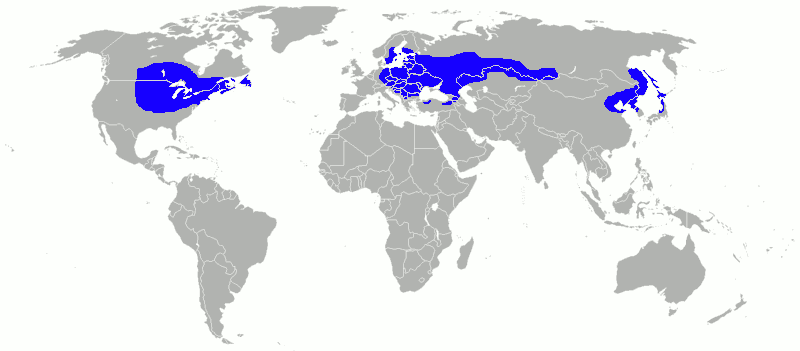
You may notice that all of these plants are natives of either eastern North America, Europe, or the northern China-Korea-Japan area. This isn't an accident - the northeastern part of the United States has a type of climate sometimes known as humid continental. There are three large areas of land on earth that have this climate:

Image from here on Wikipedia - see this article.

The native ranges of most of the common (and quite a few of the less common) garden plants that grow in the northeastern United States fall mostly within one of these three zones.

Thursday, January 28, 2010

Public transportation - 19th century - 1; 21st century - 0

A couple of days ago it was raining and over 40 degrees (Fahrenheit), and tonight it's about 8 degrees, with windchills of about -8. Such is winter in New England.

I met with an old friend and co-worker a couple of days ago - he's come back to the historical archive where I work (and he used to work) to do some research on 19th century railroads in Massachusetts, specifically the railroad that runs east-west across the state between Boston and Albany, N.Y. One interesting bit of information he provided was that according to the oldest schedules that he found, the trains in the 1850s could travel between Boston and Worcester in slightly less time than the commuter rail trains that follow the same route today. This is especially interesting (and depressing) to me because I used to travel on those commuter trains when I worked in the Boston area. It's interesting (and slightly depressing) to learn that a traveller in the pre-Civil War period could get a faster trip than present-day commuters! Granted, the seating on those early trains probably made even the most cramped old commuter rail cars today seem like luxury hotels on wheels - I think that the early seats were usually plain and rickety wood, on cars that had very limited shock absorbing capabilities.

This kind of ties in with the fact that the USA once had one of the world's best passenger rail networks, and then we basically dismantled most of it in the mid-to-late 20th century because interstate highways and automobiles seemed like a superior method of travel at the time. You could once travel to almost any small city and many decent-sized towns in the USA by rail. Even the electric streetcar networks were pretty comprehensive - I heard somewhere that in the early 20th century one could travel all the way from Boston to Chicago using only electric streetcars, although nobody would actually travel that way because you would probably have to change streetcar lines 30 times or something. I'm not sure if that is actually true or not!