The good news is that I have agreed on a price for a house of my own, one that is nice and only about 2 miles from where I work. The agreed price is $156,000, which is very reasonable in this part of Massachusetts even for a small house in a down market. I haven't talked much about my house-hunting, but it has been an interesting process, and there are still quite a few steps left. I am going to the inspection on Monday.
The bad news is that my grandmother's health is going further downhill. She is my father's mother, my one surviving grandparent, and is 94 years old. She lives down in Texas, about 100 miles southwest of Dallas and some 40 miles west of Waco, near my aunt, who visits her at least once every week. She often described me as her favorite grandchild, and we were pretty close as I was growing up. My father and I have visited her the last two Septembers for her birthday, and I still write to her from time to time. For the last year or so, however, her health has deteriorated. She sleeps a lot, has lost quite a bit of weight, and needs more assistance taking care of her everyday needs like getting dressed, etc. She has usually been unable to hold extended conversations, and sometimes gets very confused. She moved from an assisted living area into a more complete nursing home area of the same facility. Now she often completely forgets where she is, which is considerably worse than she was just this past September when I visited her. My aunt and the people at the nursing home both think that she sleeps so much at least partly to escape the confusion and anxiety that she feels because she can not remember where she is or what is going on. I feel somewhat guilty for not writing to her since earlier in November, although I believe that she mostly relies on my aunt to read my letters to her now, and may not always fully understand them.
Overall, her health and quality of life, which were not good even over a year ago, are tragically declining more and more. It happens to almost everyone eventually, but that does not make it any less painful or sad when it does happen.
Sunday, December 5, 2010


Tuesday, November 30, 2010
Random Garden Photos
Hmm, it's still three weeks to the start of winter proper, and I'm already suffering from "plant withdrawal" enough to want to post more and more garden pics. Here are three more or less random ones -


Clump of Zagreb Coriopsis - a lovely cushion of yellow color (while it lasts).
Saturday, November 27, 2010
Removing fences and flowering cacti: a random post
Clearing leaves and dead perennial foliate did not complete in the garden this year. There was also the question of the old wooden fence that my parents put up partway around an above-ground pool back when we were kids. The pool was long since taken down and replaced by more gardening space, but the fence remained. Over the last few years, it has been showing its age, so my father wanted to take it down.
 This is what we ended up with. The wooden pieces are gone, the
metal poles embedded in concrete bases that we dug out of the ground
are still here for the moment.
This is the garden area and part of the fence in the summer (the rest of the
fence bends back and is hidden behind the front part):
 Here's a more closeup view of the same area after we were finished taking
the fence down:
 The fence ran through the garden area in the lower part of the picture.
 This picture inserted for no good reason other than that I think
that as many posts as possible should have pictures taken just after sunset.
 Top-down view


 This is what we ended up with. The wooden pieces are gone, the
metal poles embedded in concrete bases that we dug out of the ground
are still here for the moment.
This is the garden area and part of the fence in the summer (the rest of the
fence bends back and is hidden behind the front part):
 Here's a more closeup view of the same area after we were finished taking
the fence down:
 The fence ran through the garden area in the lower part of the picture.
This shouldn't be much of a problem for the plants - only a couple of them were climbers, and we can get trellises for those. Almost all of them were basically sun rather than shade plants - the extra sun from the removed fence should help them or at least not hurt them.
 This picture inserted for no good reason other than that I think
that as many posts as possible should have pictures taken just after sunset.
Meanwhile, there are actually plants growing inside the house as well. They rarely get the attention that they deserve in this blog, but I couldn't ignore the Christmas cactus, which started blooming a little earlier than its name would suggest, but at the right general time of year.
 Top-down view
In my humble opinion, Christmas cacti have some of the most beautiful flowers around. They look incredible close up:


Moods of the sky ...
One thing I love about where I live is that there is a field behind the house, which is near the top of a hill. There is a great view to the west, which is a contrast to the situation of most houses in this area. Most houses either look onto a patch of woods, or into another house and yard the next street over. Over time, the sky has many different "moods".


Dramatic and contrasting:


Somber and gray, but with a bit of a lighter side:

Bright and cheerful:

A flash of light through the gloom:

Murky and mysterious:

A calm but colorful finale:

Friday, November 26, 2010
Turkeys and the "Columbian exchange"
When the group of English colonists commonly known as Pilgrims crossed the Atlantic, they brought domestic turkeys with them. When they reached what is now Massachusetts, they found wild birds of the same species living there. At the festival of the first Thanksgiving, they may well have eaten either, or both, wild and domestic turkeys.
The turkey is a native of North America only. Given this, how could European settlers have brought turkeys from Europe to North America? The answer is that turkeys had already been brought from North America to Europe in the sixteenth century. The Pilgrims were already used to eating a distinctly "American" food long before they left England or the Netherlands to come to Massachusetts.
There are several different subspecies or varieties of wild turkey in North America. The southernmost of these subspecies lives in central Mexico. It was the only variety that was domesticated. When the Spanish overran the great Mexica (Aztec) empire in Mexico, they learned about the local foods. Apparently they liked turkeys enough to bring them back to Spain not long after the conquest of Mexico. From Spain, they spread through many other parts of Europe by the end of the sixteenth century, including England.
When the bird reached England in the late sixteenth century, there was a problem with names. The Spanish referred to the birds by a version of their native Mexican name. Hardly any of the English, on the other hand, knew exactly where these birds came from. At that time, the Ottoman or Turkish Empire controlled much of eastern Europe, the Middle East, and North Africa, and was seen as strange and exotic by most people in western Europe. People tended to assume that most strange things, including strange animals and plants, came from Turkey. The large, meaty, but odd new bird became known as the "Turkey bird", because so many people assumed that it came from the empire of the Turks.
The spread of the domestic turkey from Mexico to Europe and then back across the Atlantic to more northern regions of North America is just one small example of a massive movement of domesticated and non-domesticated plants and animals known as the "Columbian exchange". It gets its name from the fact that it was the voyages of Christopher Columbus that started the exchange by encouraging further exploration, conquest, and colonization of new lands by Europeans.
Among other things, Europeans brought wheat, grapes, barley, oats, apples, peaches, oranges, pears, peas, rice, coffee, tea, sugarcane, pigs, sheep, cows, horses, honeybees, and a bunch of diseases from the "Old World"continents of Europe, Africa, and Asia, to the lands they considered a "New World". In return, they took, among other things, corn/maize, potatoes, chili peppers, beans, squash, sweet potatoes, cacao/chocolate, tomatoes, and pineapples back to not only Europe but to other parts of the "Old World". (Turkeys seem to have been the only domesticated animal taken in significant numbers from either American continent to the "Old World".
By doing this, they drastically changed the world's economy. Potatoes in northern and western Europe produced larger quantities of food on the same amount of land than traditional crops like wheat. This eventually led to a great increase of population in northern and western Europe, which probably helped make the industrial revolution possible creating a large number of former peasants who could not find work in rural areas and so came to early factories looking for work.
Corn/maize had little impact in northern or western Europe, but it became a major crop in parts of southern and eastern Europe. Its greatest impact, though, was probably in tropical Africa. Corn varieties that came from wet tropical regions of North and South America grew well in wet tropical areas of Africa, and as the potatoes did in Europe, they produced more food on the same amount of land than traditional local crops like yams. As in Europe, the new crops helped support a major increase in population, but instead of the Industrial Revolution, the extra population in Africa had a much worse fate. All of those extra people probably helped encourage various kingdoms and tribes in western and central Africa to go to war more often, and capture people from enemy kingdoms and tribes as slaves. Many of these slaves were sold to European slave traders, who took them to plantations in the American continents and the Caribbean.
So, just two crops going from the Americas to the "Old World" probably helped create both the African Slave Trade and the Industrial Revolution. The effects of the "Columbian Exchange" certainly went well beyond what was eaten at the first Thanksgiving!
Sunday, November 14, 2010
Plant and garden pics from this year
 Lilacs blooming in front of the house in May
 Pyrethrum or Painted Daisies in bloom, May
(species possibly Chrysanthemum coccineum also called
Tanacetum coccineum)
 Unfortunately blurred closeup of a flower whose name escapes me at the moment,
taken in May.
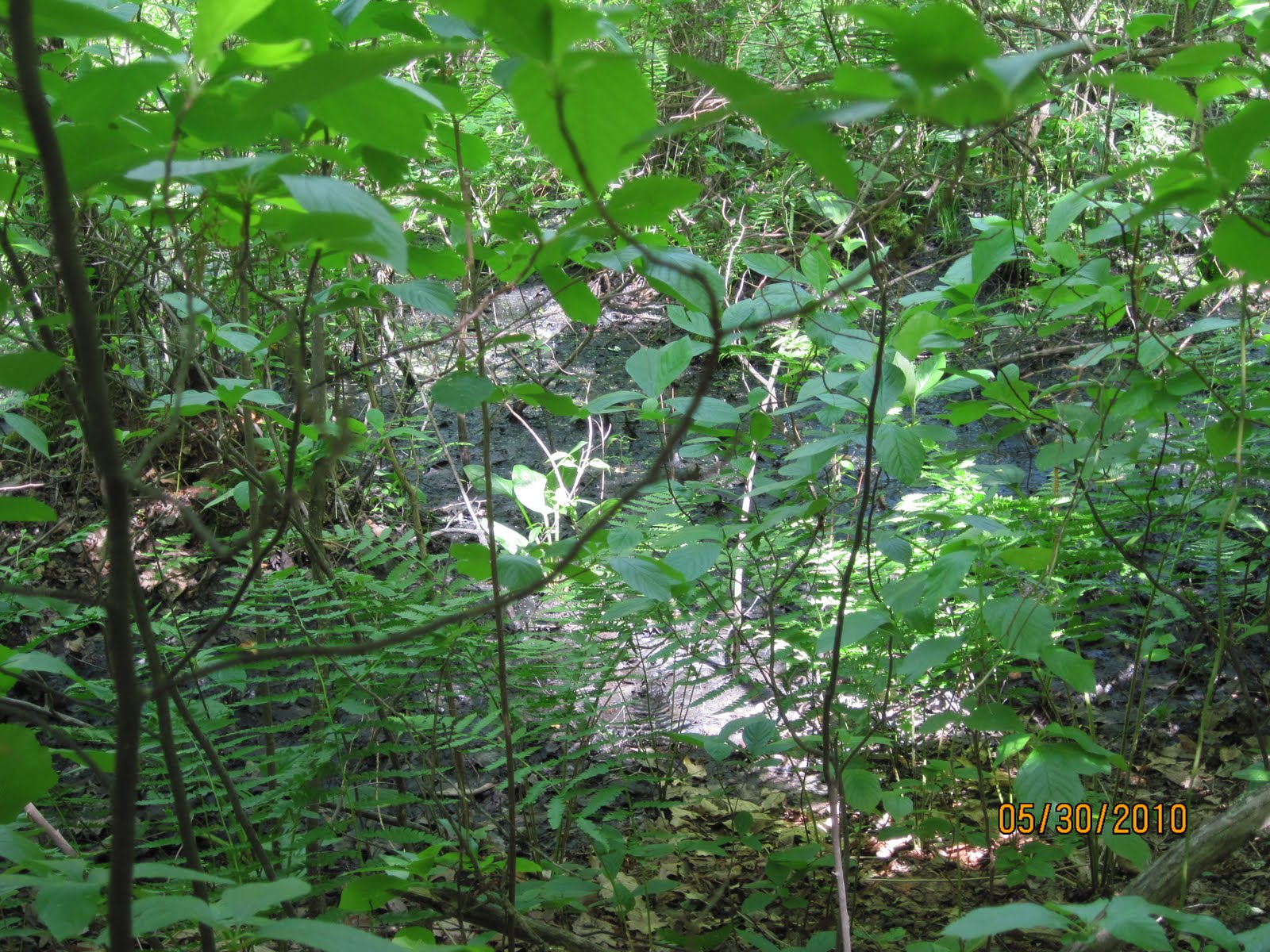 Edge of a swamp area near where I live.

Emerging catkins (long clumps of tiny flowers) and leaves on a
white oak (Quercus alba), taken in May
 Clusters of small white flowers on a
black cherry (Prunus serotina), taken in May.
 Peonies in bloom, taken in June
 Sunset from the back yard, taken in June
Saturday, November 6, 2010
On a different note, I looking at some of my photos taken during the last 2 or 3 months, and found a few that might be worthy of posting:
 A big moth of some kind on a screen door to the back porch. It was about 1.5 inches wide,
with a distinctive color pattern.
 A small tree growing alongside the sidewalk along the main street in my town.
I believe that it might be an American Chestnut growing back from
the remains of a much older one - the leaves seem to be the right size, shape
and configuration.
 An Eastern Hemlock (Tsuga canadensis) in the front yard. At about 20 years old,
it has gotten a little too tall to easily fit into a picture taken from near the house.
 A fall-flowering wildflower - I'm not sure which one, but it was pretty.
Note the 3-leaved menace, poison ivy, sneaking into the picture to the
upper left. By now, they've both probably gone dormant for the winter.
 Maple trees showing patches of color a little more than a month ago.
They might be either Sugar maple (Acer saccharum) or Red maple (Acer rubrum)-
I can't tell from this picture. By now, they've almost certainly lost close to 100%
of their leaves.
 A single Red maple leaf lying on a juniper bush in the backyard, looking kind of like
the Canadian flag would look of the Canadian flag had a background
of green juniper foliage, and a differently shaped maple leaf with dew on it.
 Sometimes individual maple leaves get patches of color while the rest is still green.
This might be a Silver maple based on the shape of the leaves, which look more
deeply lobed than either Sugar or Red maple leaves.
 White oak (Quercus alba) fall foliage, from a small branch that broke off a white oak next door.
Oaks usually don't get showy fall foliage, but white oaks sometimes get
this sort of burgundy-like color.
 Virginia creeper (Parthenocissus quinquefolia), a native vine related to wild grapes,
often gets bright red foliate in the early autumn. The neighboring invasive
Oriental bittersweet (Celastrus orbiculatus) to either side of it remains green later
into the fall, and then turns yellow briefly before dropping off.
 Ginkgo biloba is a unique species of tree that is the last survivor of what was once a widespread group of plants. It is also a popular ornamental tree in this area, since it can grow
in heavily built-up areas, has a nice, symmetrical form, and a unique shape of leaf.
Ginkgo has separate male and female trees. The male trees are more popular to plant because
they do not produce any fruit - ginkgo fruit is edible but gives of an unpleasant smell.
I had assumed that this was a male tree until the fall when I saw what were quite clearly fruits hanging in the branches. I didn't notice any unpleasant smell, either. Either I was just
lucky or I'm unusually insensitive to the smell.
Ginkgo leaves turn a nice bright golden yellow later in the fall, and then drop off quickly.
One day last week I noticed that this particular tree was almost bare, and all the fallen leaves
formed a nice bright yellow carpet on the ground. I'm not sure what happened to the fruit.
 A big moth of some kind on a screen door to the back porch. It was about 1.5 inches wide,
with a distinctive color pattern.
 A small tree growing alongside the sidewalk along the main street in my town.
I believe that it might be an American Chestnut growing back from
the remains of a much older one - the leaves seem to be the right size, shape
and configuration.
 An Eastern Hemlock (Tsuga canadensis) in the front yard. At about 20 years old,
it has gotten a little too tall to easily fit into a picture taken from near the house.
 A fall-flowering wildflower - I'm not sure which one, but it was pretty.
Note the 3-leaved menace, poison ivy, sneaking into the picture to the
upper left. By now, they've both probably gone dormant for the winter.
 Maple trees showing patches of color a little more than a month ago.
They might be either Sugar maple (Acer saccharum) or Red maple (Acer rubrum)-
I can't tell from this picture. By now, they've almost certainly lost close to 100%
of their leaves.
 A single Red maple leaf lying on a juniper bush in the backyard, looking kind of like
the Canadian flag would look of the Canadian flag had a background
of green juniper foliage, and a differently shaped maple leaf with dew on it.
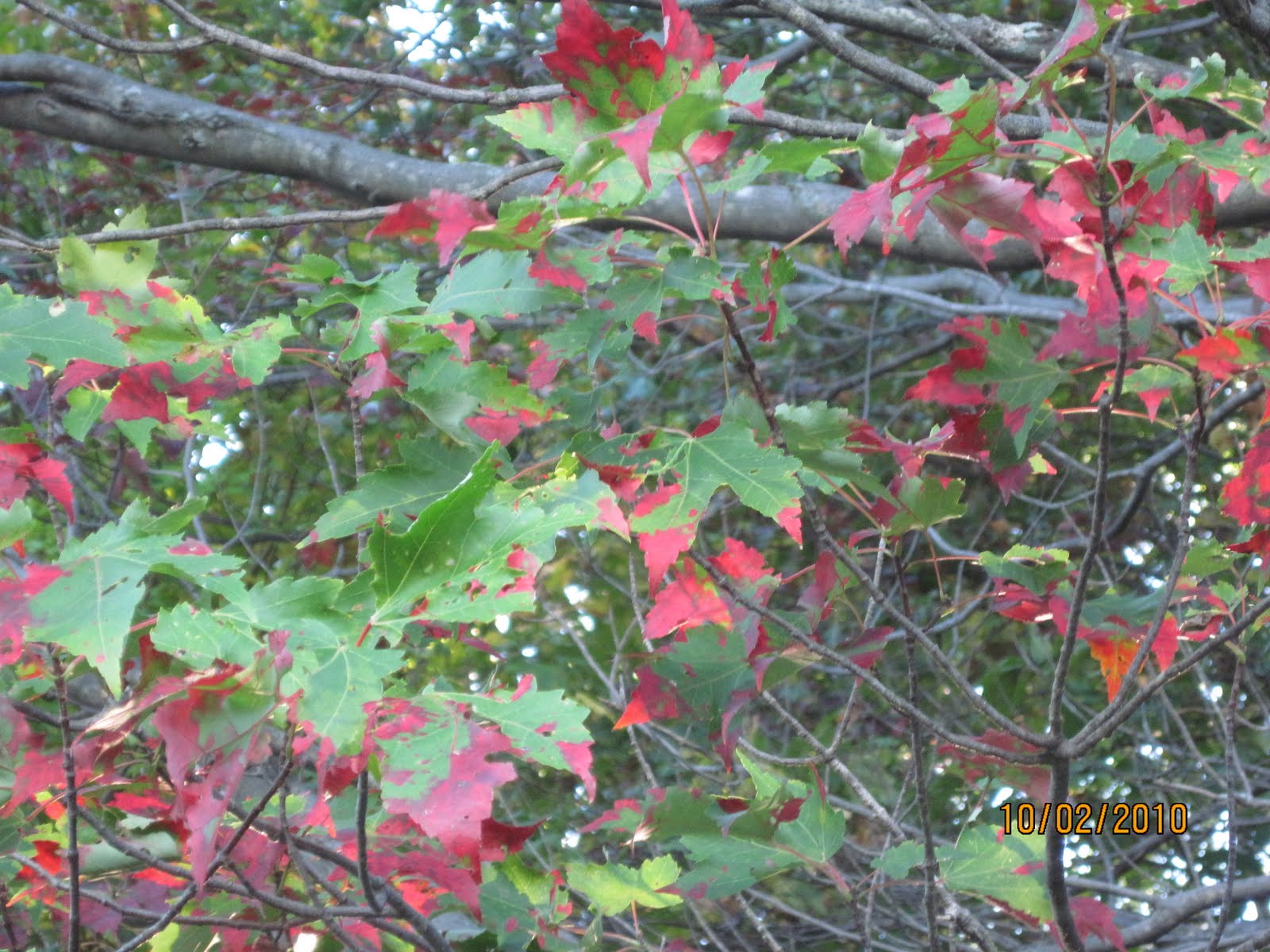 Sometimes individual maple leaves get patches of color while the rest is still green.
This might be a Silver maple based on the shape of the leaves, which look more
deeply lobed than either Sugar or Red maple leaves.
 White oak (Quercus alba) fall foliage, from a small branch that broke off a white oak next door.
Oaks usually don't get showy fall foliage, but white oaks sometimes get
this sort of burgundy-like color.
 Virginia creeper (Parthenocissus quinquefolia), a native vine related to wild grapes,
often gets bright red foliate in the early autumn. The neighboring invasive
Oriental bittersweet (Celastrus orbiculatus) to either side of it remains green later
into the fall, and then turns yellow briefly before dropping off.
 Ginkgo biloba is a unique species of tree that is the last survivor of what was once a widespread group of plants. It is also a popular ornamental tree in this area, since it can grow
in heavily built-up areas, has a nice, symmetrical form, and a unique shape of leaf.
Ginkgo has separate male and female trees. The male trees are more popular to plant because
they do not produce any fruit - ginkgo fruit is edible but gives of an unpleasant smell.
I had assumed that this was a male tree until the fall when I saw what were quite clearly fruits hanging in the branches. I didn't notice any unpleasant smell, either. Either I was just
lucky or I'm unusually insensitive to the smell.
Ginkgo leaves turn a nice bright golden yellow later in the fall, and then drop off quickly.
One day last week I noticed that this particular tree was almost bare, and all the fallen leaves
formed a nice bright yellow carpet on the ground. I'm not sure what happened to the fruit.
Subscribe to:
Posts (Atom)