Showing posts with label gardening. Show all posts

Sunday, May 29, 2011

Working with a "semi-wild" garden

I like to think of the garden at my new house as a "semi-wild" or a "woodland" garden.  It's unruly and unkempt, but also very lush and full of healthy plants that seem to like their current location.  There is an abundant mixture of geraniums, ferns, lily-of-the-valley, hostas, irises, daylilies, barberries, blackberries, violets, strawberries, and a couple of other plants that look nice enough but that I haven't identified.  There are also, however, plenty of weeds, including tree seedlings and saplings (some resprouting from stumps), the invasive weeds garlic mustard and oriental bittersweet, and of course, the bane of my existence, poison ivy. 

I've ruled out trying to dig a large part of it up and starting over.  I don't have the energy for that, and it isn't my style anyways.  I like to try to work with the plants I have as much as possible.  I see my job as removing the weeds, encouraging the existing plants that I like, and making a few additions of my own wherever there are gaps.  So far, I have gotten a good start on the first two.  It isn't always the easiest job.  I need to carefully separate the weeds from the desired plants when the two are all mixed together in a lush mass of plants.  I have to try and avoid stepping on anything, which is almost impossible in many parts of the garden.  With some plants, especially the blackberries and barberries, I want to have a few of them in the garden, but not too many, so I need to decide which to pull and which to leave.  The blackberries and barberries also have thorns, which catch on clothing and occasionally break through even leather gardening gloves.  Then, of course, I always need to be on the lookout for poison ivy.  I've brushed it with my gloves a few times already, but I haven't actually gotten any rashes.  I get a little paranoid about touching things with my gardening gloves on, however, since poison ivy oil can be transferred from one object to another.  I don't think I've touched enough poison ivy with my gloves for this to be a serious problem, but I'm not 100% sure. With Obsessive Compulsive Disorder I can easily get too paranoid and spend more time worrying about poison ivy than actually gardening, if I don't fight my excessive worries.  All in all, I think I have done a pretty good job so far - both with the gardening and with the Obsessive Compulsive Disorder.
Here are a couple of pictures at different angles of the main garden bed.  I've done some more weeding since these were taken, but it basically looks very similar:

The little pink-white flowers are geraniums.

Meanwhile, in other parts of the yard, two bushes are in full bloom without me having to do anything whatsoever.  The first is the rhododendron in front of the house, which turns out to have flowers of a lovely  lavender color.


Here's a closeup, with an ant crawling around one of the flowers.

Here is one clump of flowers near the ground ...
... and what I think is the same branch of the plant in March, when there was still snow on the ground and the flowers were enclosed in a tight bud:

The second bush in full bloom now is a Spirea of some kind, with pure white flowers :

Here is a closeup of the little clumps of flowers:

Unfortunately, neither the rhododendron nor the spirea will flower for long - very few flowering bushes have long-lived flowers.  Still, there should be plenty of more flowers coming - the irises are just starting to open, and they are beautiful.  Unfortunately, I broke my old digital camera yesterday by dropping it.  Fortunately, I got a new and (hopefully) better camera today, and I should be ready to take some more pictures (as well as pulling some more weeds) tomorrow.

Tuesday, December 7, 2010

Random Garden Photos 2

I think that I should make this a regular feature over the course of the winter.  Hopefully other people will enjoy them, and I will get to look at some digital plants (and animals) that will partly make up for the lack of non-dormant plants outside now!

Honeybee on azalea flowers.


Pieris or Japanese Andromeda with new growth in the spring.
This variety has new growth that is red, which only gradually fades
to green by early summer.  To the left, a large hydrangea is just
starting to "leaf out".


Columbine hybrid with multiple layers of petals.

A perfect spring day in mid-May.  Scenes like this look especially beautiful
after month after month of drab, dormant ground in winter and early spring.

Tuesday, August 10, 2010

Going to seed

The garden that I take care isn't looking so hot these days. It has an abundance of plants that flower in spring and early summer. It doesn't have nearly as much that thrives in mid to late summer. When you add in the fact that it's been relatively hot and dry for the past two months (at least by Massachusetts standards), and that I prefer to avoid heavy watering unless the plants look like they are in danger of actually dieing - it all adds up to a garden that looks somewhat wilting and ratty, in addition to lacking many flowers.
In the picture directly above, half of the green comes from weeds (mostly goldenrod, the tall ones with numerous small leaves). I don't have the heart to rip them out when they provide greenery and little yellow flower spikes as well.


A big patch of tradescentia plus heat and lack of water plus neglect equals a matted mess of dried up old tradescentia plants.


Mayapple (Podophyllum peltatum), with its lush leaves scorched brown by too much sun and not enough water. The yellow fruit has matured, though - the entire plant, including immature fruit, is poisonous, but the mature fruit is supposedly fine to eat (I haven't tried it myself). This is really a shade plant, which I unwisely planted in almost full sun. It does great in the spring and very early summer, then gets scorched as the weather gets hotter and drier. This has happened every year for at least 5 or 6 years - this year is just a little worse than usual.


Purple coneflowers (Echinacea purpurea), mostly past their prime and starting to go to seed. These may be the best self-seeding garden flowers that I have ever seen. Each individual plant seems to live about 2-4 years, but no new plants have been added to the garden for probably 15 years or so. All of the plants growing there now are self-seeded.


It may be a "lazy gardener's technique", but I have no problem with letting weeds that I consider attractive grow in parts of the garden that are thin on proper domesticated plants. This is a clump of milkweed (Asclepias syriaca), with not yet opened seedpods near the top of some of the plants. It will come as no surprise to most gardeners that the weeds, whether desired or not desired, have tended to cope with the heat and low rainfall better than most of the cultivated plants!

Monday, June 14, 2010

Yet more garden photos


One of these days, I'll make a post that requires more thought, but for now, more garden photos will have to so ...

Here you can make out yellow Coreopsis in bloom in the center, and several foxgloves
with their long spikes of purple flowers above then and further from the camera


A self-seeded Rose Campion (Lychnis coronaria) with small magenta-colored flowers
is growing on what should be the walkway to the left of center near the bottom of the picture. I decided not to pull it up because I have a general policy of not removing nice flowers that are kind enough to grow without even being deliberately planted.


Self-seeded foxgloves (Digitalis purpurea, I think)


Hostas with a Japanese painted fern kind of squashed between them


Common Milkweed (Asclepius syriaca) - another self-seeded plant, and a native. As the name implies, it is generally considered a weed, but IMHO it's a pretty and not-terribly-aggressive one that is conveniently filling in a spot that was bare before, so I decided that it's welcome. Behind it is a large clump of Oregano - first planted a decade ago by mom as a source of fresh spices, it quickly spread far beyond our puny needs for cooking, and now there are probably 15 clumps of it growing in various parts of the flower beds, which need to be partly torn out every year of two to prevent them from pushing out neighboring plants. It stays from a combination of my inertia and the fact that the flowers, while tiny, attract lots of insects, including butterflies and occasionally some odd orange and iridescent blue-colored hornets that I have never seen near any other flower in the garden.

Saturday, May 22, 2010

Garden geography

One of the things that I find interesting about gardening is something that many gardeners probably don't think very much about - where the plants in the garden originally came from. Most garden plants, whether flowers, herbs, or vegetables, have been selectively bred to some degree to produce larger flowers or leaves or roots, but most of them still have a lot in common with their wild ancestors. So, in a sense, even an average suburban garden is a sort of herbarium or botanical garden with specimens that originate in various parts of the world. Here are just a few samples from my particular garden:


Dicentra eximia - Wild bleeding heart; native to
eastern United States, mainly Appalachian mountains


Syringa vulgaris - Common lilac; native to the
Balkan peninsula of southeastern Europe


Podophyllum peltatum - Mayapple; native to
eastern United States


Cercis canadensis - Eastern redbud; native to
eastern United States (but not Canada, in spite of the name)


Centaurea cyanus - Cornflower or Bachelor's button; native to
most parts of Europe


Rosa carolina - Pasture rose or Carolina rose; native
to eastern United States and southeastern Canada


Rudbeckia hirta - Black-eyed susan; native to
central and eastern United States and Canada


Athyrium niponicum - Japanese painted fern; native to
Japan (duh!), northern China, Korea, Taiwan


Leucanthemum x superbum - Shasta daisy; hybrid of two species
native to Europe -- with Apis mellifera - Honey bee; native to parts of Asia,
Africa, and Europe


Dicentra spectabilis - Bleeding heart or Lyre-flower; native to
southeastern Siberia, northern China, Korea, and Japan


Rhododendron maximum - Great rhododendron; native to
eastern United States and southeastern Canada


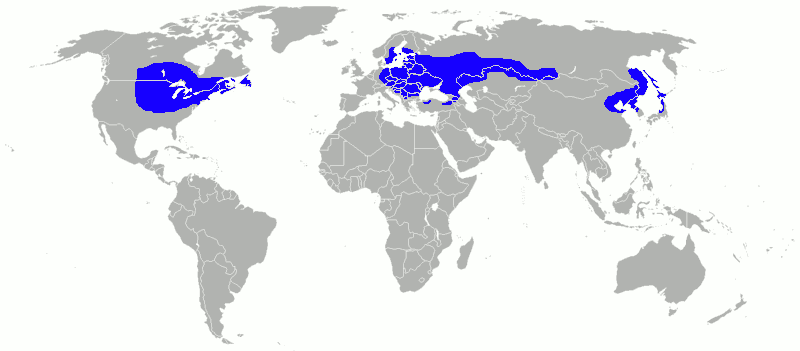
You may notice that all of these plants are natives of either eastern North America, Europe, or the northern China-Korea-Japan area. This isn't an accident - the northeastern part of the United States has a type of climate sometimes known as humid continental. There are three large areas of land on earth that have this climate:

Image from here on Wikipedia - see this article.

The native ranges of most of the common (and quite a few of the less common) garden plants that grow in the northeastern United States fall mostly within one of these three zones.

Saturday, May 8, 2010

Tulips and other flowers of mid-spring

I was so happy to see the tulips actually get a chance to bloom this year instead of being eaten by deer that I took lots of photographs. There are plenty of other flowers that have been blooming over the past 10 days or so, and I didn't completely neglect them with the camera.

First, the tulips. Most of these photos were actually taken last weekend. Unfortunately, tulips are not very long-lasting flowers once they open, and virtually all of the flowers pictured here have dropped all of their petals. Today I clipped off a lot of the flower heads, because bare flower heads after the petals fall off look rather unattractive (in my opinion), plus if they actually produce seeds, this will use some of the sugar and other nutrients that the plants live on. If they don't produce seeds, more of the nutrients will go down into the bulb, resulting in a larger plant next year. Or so I've heard - I probably should check more closely to see if I'm wasting my time!

These first two pictures are two views of the same tulip. It is the only one with this color combination in the garden - I especially like the combination of colors when the flower is backlit.


Red and white striped tulip with colors that remind me of a candy cane. (It doesn't take much to remind me of one kind of junk food or another.) These I like how the outer "petals" flare out like little tongues. (The "outer petals" are actually sepals in tulips. For many kinds of flowers, the sepals are the green lobes that make up the outer covering of the flower before it opens, and which usually shrivel up or become inconspicuous after the flower opens and the petals come out. In tulips, however, the sepals change color to match the petals as the flower starts to open, and remain an important part of the flower until they drop off around the same time as the petals.)


Pinkish tulip with a lighter central area and sepals that flare out somewhat less than the previous flower.


Large yellow tulip with dark center - and a small spider crawling on the right side.


A tulip of the same type as the previous, except with a single red stripe.


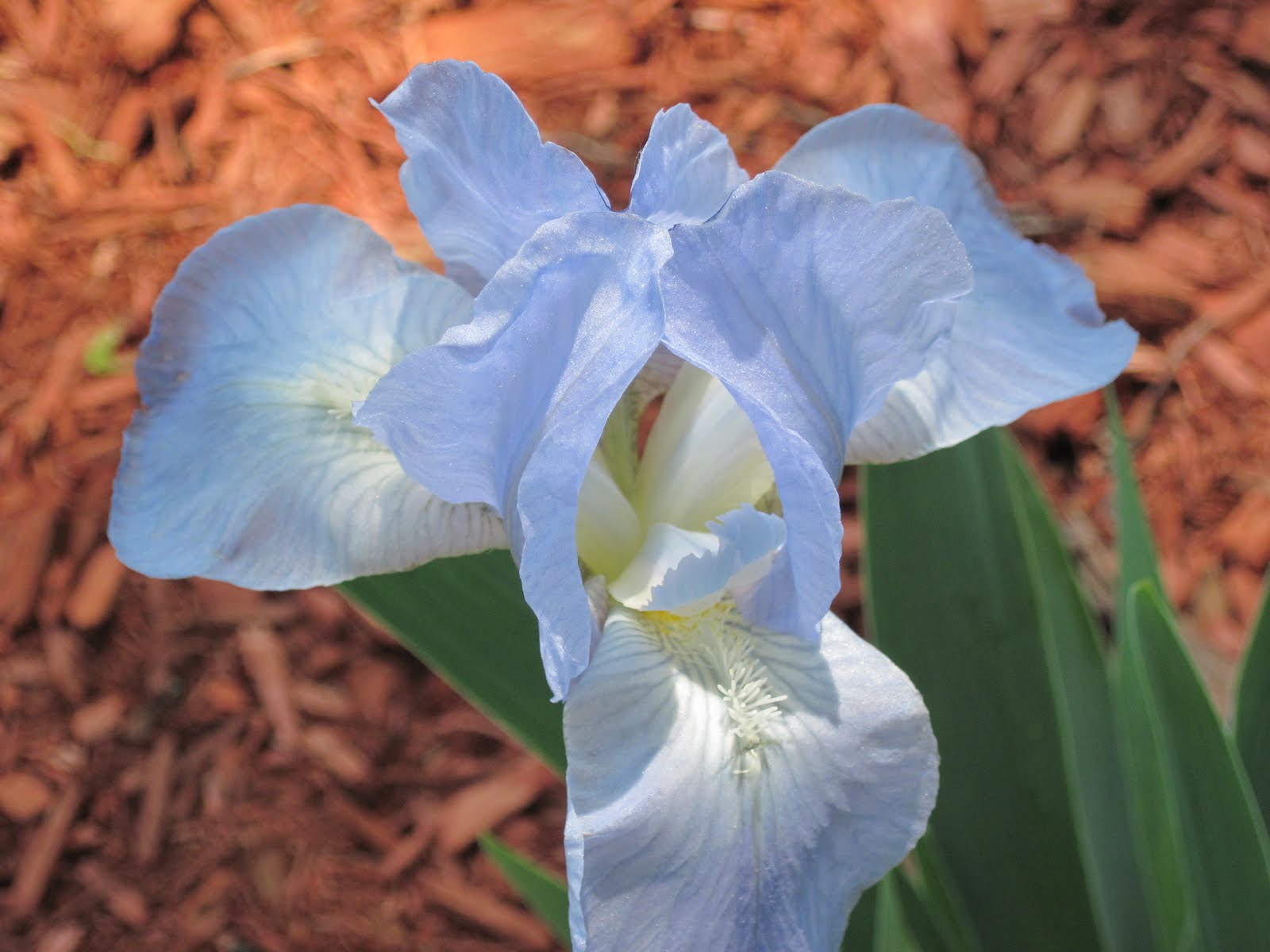
Some type of pale blue iris - as you may have noticed, I'm not good at remembering the names of different varieties or cultivars! All I know is that I got this at a local garden club sale, and that it is a short variety, with the the flowers no more than 6-8 inches above the ground and the leaves not much taller.


A closeup of the flowers of an azalea or dwarf rhododendron (I can't remember which) in front of the house. Notice the bee at work gathering nectar from the flower in the center - I believe this is a honey bee.

A broader view of the same azalea along the walkway to the front door of Dad's house (the house where I spent most of my childhood and have lived for some of my adult years as well.)


A cluster of pink tulips, with some white and red tulips in front of them (kind of washed out from the late afternoon sunlight glaring off the white flowers). The pale blue irises are at upper left, further from the camera than the tulips - you can see how they are pretty short.


An azalea bush with reddish flowers to the left, pink and mixed pink and white tulips to the right. There are a mix of lower-growing plants, including a few blue anemones to the left, a few purplish grape hyacinths to the right, the plant with the gray-colored foliage whose name I can never remember, and a bunch of lily-of-the valley sprouting just about everywhere it can. (Lily of the Valley spreads itself all too well by underground runners. Mom planted it years ago against her better judgment in a location a few feet to the left of the left edge of this photo, and surrounded it with a plastic barrier 6 inches deep to prevent it from spreading as recommended in the garden books. This worked for 2 or 3 years, but then its underground runners found some little breach and it has been spreading to a wider part of the garden each year.)


A patriotic grouping of flowers - red azalea bush, white candytuft (Iberis sempervirens), and blue anemones.


A nice ensemble photo, with 5 colors of tulip (multiple pinks and purples, 2 white with a little red, and a single solid red and single pale-pink/yellow) growing along with bleeding hearts (background), candytuft (lower left), and yellow alyssum (right). An azalea bush is just above the alyssum, but this one has not started to flower yet.


Pink, purple, and red tulips again, along with bleeding hearts and alyssum, and the pale blue irises (which were hidden behind another some of the tulips in the previous picture.)