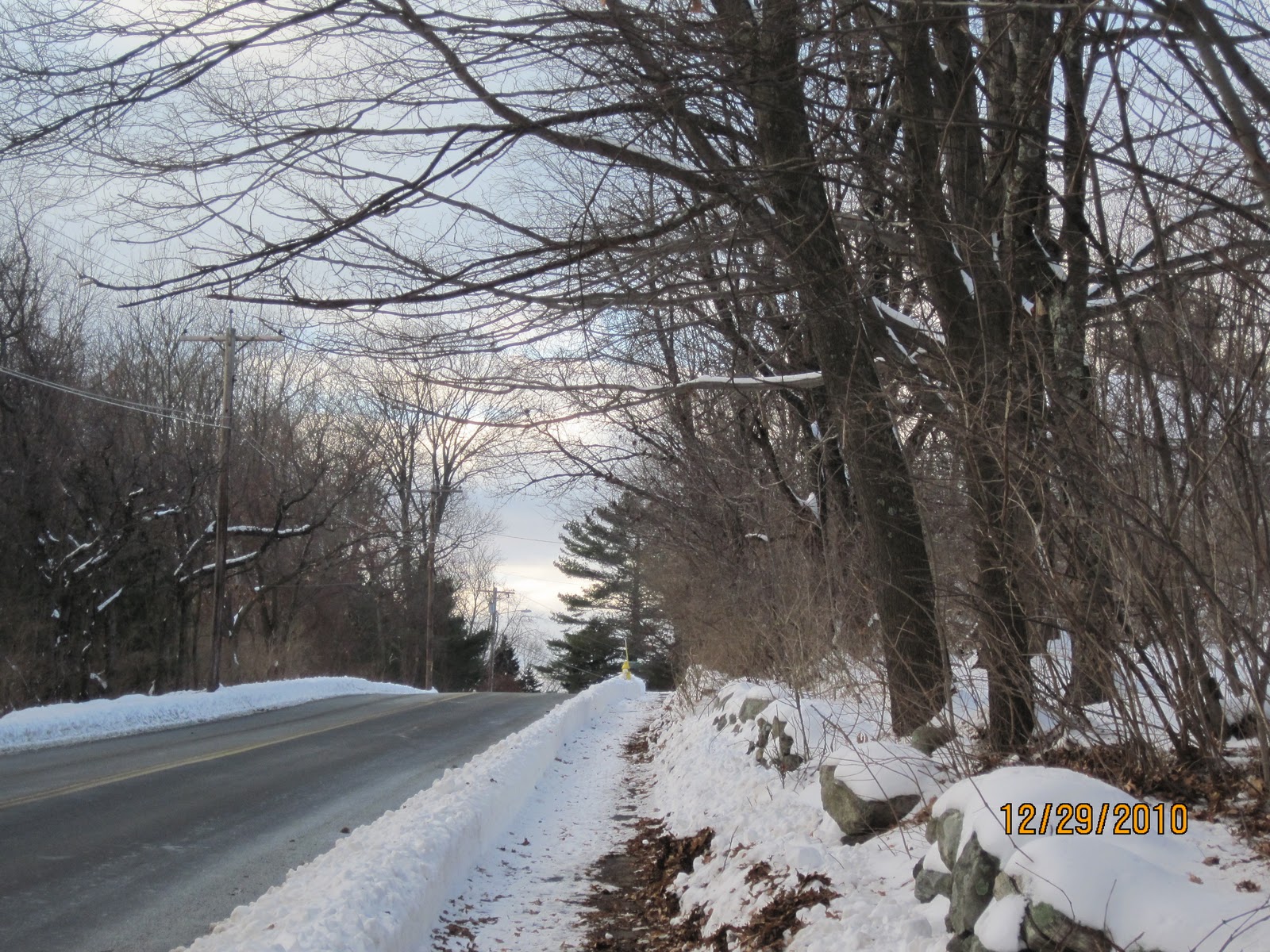
My new home has many virtues, but dramatic sunset vistas that make for good photographs are not among them. Instead, my house is surrounded by other houses and trees, which is entirely typical of New England. In this part of the country, being able to look at landscapes that are many miles distant from one's own home is more of a privilege than a standard feature.
Nonetheless, there are a few good views that I've been able to get over the past few weeks:
Showing posts with label trees. Show all posts
Saturday, March 5, 2011
Saturday, January 29, 2011
Icicles and trees
I've spent the past week getting settled into a new house that I actually own. This house has many advantages. Some of the most basic are -
1. It's a nice place - 2 bedrooms, a kitchen/dining area, and a living room. This is more space than I really need, but not necessarily more space than my books other stuff need.
2. It's in a good neighborhood.
3. It's only about 3 miles from work, leading to a very short commute.
There are some disadvantages, though, which are small compared to the advantages but nonetheless present. The biggest disadvantage is that I live on a dirt road. It gets plowed when it snows, but it isn't possible to plow a dirt road as closely as a paved one, so there is still lots of snow. The area is also hilly. This could describe 90% of central Massachusetts, so it's no surprise, but hills plus snow plus a car that lacks four wheel drive and was definitely not designed for either dirt or snowy roads makes driving ... interesting, to put it politely.
(Another disadvantage is that I now owe more money than I ever have before, but that's sort of an automatic hazard of buying a house unless you are wealthy or buying a cheaper house than what you previously owned.)
In any case, I will leave you with a couple of pictures. First, icicles on my house. These have grown so large that I am afraid to disturb them:
Second, a big tree that overhangs my driveway. It's a Norway Spruce (Picea abies), I think.
1. It's a nice place - 2 bedrooms, a kitchen/dining area, and a living room. This is more space than I really need, but not necessarily more space than my books other stuff need.
2. It's in a good neighborhood.
3. It's only about 3 miles from work, leading to a very short commute.
There are some disadvantages, though, which are small compared to the advantages but nonetheless present. The biggest disadvantage is that I live on a dirt road. It gets plowed when it snows, but it isn't possible to plow a dirt road as closely as a paved one, so there is still lots of snow. The area is also hilly. This could describe 90% of central Massachusetts, so it's no surprise, but hills plus snow plus a car that lacks four wheel drive and was definitely not designed for either dirt or snowy roads makes driving ... interesting, to put it politely.
(Another disadvantage is that I now owe more money than I ever have before, but that's sort of an automatic hazard of buying a house unless you are wealthy or buying a cheaper house than what you previously owned.)
In any case, I will leave you with a couple of pictures. First, icicles on my house. These have grown so large that I am afraid to disturb them:
Second, a big tree that overhangs my driveway. It's a Norway Spruce (Picea abies), I think.
Thursday, December 30, 2010
Holiday plant and photos from a walk
A few pictures that I took yesterday:
An indoor tropical plant (I don't know the name), decked out in appropriate
holiday season colors.
An old beech tree that I saw along a walk, with a little plaque. This type gets
purple leaves in the summer, and is very nice. Unfortunately, they don't seem to
be planted very much these days, possibly because grass won't grow underneath them.
Random forest scene.
Random roadside scene.
Two pictures at Dad's house, where I spent most of my childhood
(and some of my adulthood). The first is a view from the driveway,
the second is a view of the house itself later in the afternoon, just before sunset.
Saturday, November 6, 2010
On a different note, I looking at some of my photos taken during the last 2 or 3 months, and found a few that might be worthy of posting:
A big moth of some kind on a screen door to the back porch. It was about 1.5 inches wide,
with a distinctive color pattern.
A small tree growing alongside the sidewalk along the main street in my town.
I believe that it might be an American Chestnut growing back from
the remains of a much older one - the leaves seem to be the right size, shape
and configuration.
An Eastern Hemlock (Tsuga canadensis) in the front yard. At about 20 years old,
it has gotten a little too tall to easily fit into a picture taken from near the house.
A fall-flowering wildflower - I'm not sure which one, but it was pretty.
Note the 3-leaved menace, poison ivy, sneaking into the picture to the
upper left. By now, they've both probably gone dormant for the winter.
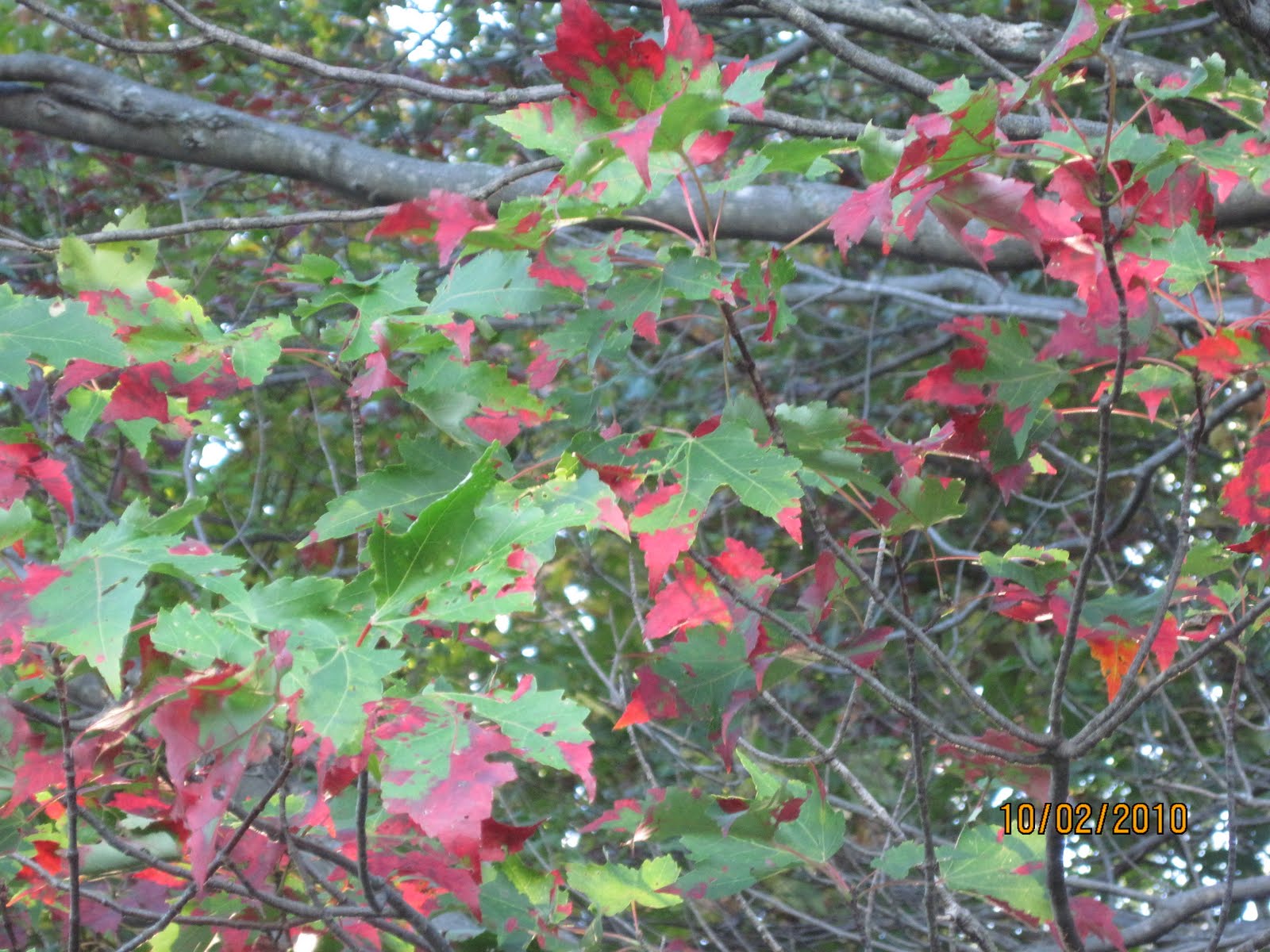
Maple trees showing patches of color a little more than a month ago.
They might be either Sugar maple (Acer saccharum) or Red maple (Acer rubrum)-
I can't tell from this picture. By now, they've almost certainly lost close to 100%
of their leaves.
A single Red maple leaf lying on a juniper bush in the backyard, looking kind of like
the Canadian flag would look of the Canadian flag had a background
of green juniper foliage, and a differently shaped maple leaf with dew on it.
Sometimes individual maple leaves get patches of color while the rest is still green.
This might be a Silver maple based on the shape of the leaves, which look more
deeply lobed than either Sugar or Red maple leaves.
White oak (Quercus alba) fall foliage, from a small branch that broke off a white oak next door.
Oaks usually don't get showy fall foliage, but white oaks sometimes get
this sort of burgundy-like color.
Virginia creeper (Parthenocissus quinquefolia), a native vine related to wild grapes,
often gets bright red foliate in the early autumn. The neighboring invasive
Oriental bittersweet (Celastrus orbiculatus) to either side of it remains green later
into the fall, and then turns yellow briefly before dropping off.
Ginkgo biloba is a unique species of tree that is the last survivor of what was once a widespread group of plants. It is also a popular ornamental tree in this area, since it can grow
in heavily built-up areas, has a nice, symmetrical form, and a unique shape of leaf.
Ginkgo has separate male and female trees. The male trees are more popular to plant because
they do not produce any fruit - ginkgo fruit is edible but gives of an unpleasant smell.
I had assumed that this was a male tree until the fall when I saw what were quite clearly fruits hanging in the branches. I didn't notice any unpleasant smell, either. Either I was just
lucky or I'm unusually insensitive to the smell.
Ginkgo leaves turn a nice bright golden yellow later in the fall, and then drop off quickly.
One day last week I noticed that this particular tree was almost bare, and all the fallen leaves
formed a nice bright yellow carpet on the ground. I'm not sure what happened to the fruit.
with a distinctive color pattern.
I believe that it might be an American Chestnut growing back from
the remains of a much older one - the leaves seem to be the right size, shape
and configuration.
An Eastern Hemlock (Tsuga canadensis) in the front yard. At about 20 years old,it has gotten a little too tall to easily fit into a picture taken from near the house.
Note the 3-leaved menace, poison ivy, sneaking into the picture to the
upper left. By now, they've both probably gone dormant for the winter.
They might be either Sugar maple (Acer saccharum) or Red maple (Acer rubrum)-
I can't tell from this picture. By now, they've almost certainly lost close to 100%
of their leaves.
the Canadian flag would look of the Canadian flag had a background
of green juniper foliage, and a differently shaped maple leaf with dew on it.
This might be a Silver maple based on the shape of the leaves, which look more
deeply lobed than either Sugar or Red maple leaves.
White oak (Quercus alba) fall foliage, from a small branch that broke off a white oak next door.Oaks usually don't get showy fall foliage, but white oaks sometimes get
this sort of burgundy-like color.
often gets bright red foliate in the early autumn. The neighboring invasive
Oriental bittersweet (Celastrus orbiculatus) to either side of it remains green later
into the fall, and then turns yellow briefly before dropping off.
Ginkgo biloba is a unique species of tree that is the last survivor of what was once a widespread group of plants. It is also a popular ornamental tree in this area, since it can growin heavily built-up areas, has a nice, symmetrical form, and a unique shape of leaf.
Ginkgo has separate male and female trees. The male trees are more popular to plant because
they do not produce any fruit - ginkgo fruit is edible but gives of an unpleasant smell.
I had assumed that this was a male tree until the fall when I saw what were quite clearly fruits hanging in the branches. I didn't notice any unpleasant smell, either. Either I was just
lucky or I'm unusually insensitive to the smell.
Ginkgo leaves turn a nice bright golden yellow later in the fall, and then drop off quickly.
One day last week I noticed that this particular tree was almost bare, and all the fallen leaves
formed a nice bright yellow carpet on the ground. I'm not sure what happened to the fruit.
Saturday, May 29, 2010
Tulip tree
The first time I remember seeing a tulip tree (Liriodendron tulipifera) was during a family trip to Virginia. I didn't think that it grew as far north as Massachusetts. I was quite wrong. It's far from common, but it is occasionally planted as a landscape tree, and can survive. When I started at my current job a couple of years ago, I realized when spring came that there was a big specimen growing right next to the parking lot.
It's impossible to fit the whole tree into one picture from the parking lot.The tulip tree, aka yellow poplar, is a native of much of the United States east of the Mississippi, more common in the southeast but obviously capable of growing as far north as Massachusetts - though we are on the extreme northern edge of its range. It's a very distinctive and remarkable tree. In sheer size, it can be one of the largest trees in eastern North America, growing to more than 160 feet/50 meters tall in the more southern parts of its range. The leaves, flowers, and seeds are very distinctive and not easy to mistake for anything else once you get a close look at them.
The most distinctive feature of all, and the one that gives the tree its name, are the flowers. They are large and showy, a mixture of yellow, orange, and green, and shaped somewhat like tulips - hence the name for the tree. Unfortunately, the flowers tend to be mostly on the middle and upper branches of the tree, so it can be difficult to get a good closeup, especially on a fairly large tree.
Tulip tree flowers - pale yellow and orange in color
The most distinctive feature of all, and the one that gives the tree its name, are the flowers. They are large and showy, a mixture of yellow, orange, and green, and shaped somewhat like tulips - hence the name for the tree. Unfortunately, the flowers tend to be mostly on the middle and upper branches of the tree, so it can be difficult to get a good closeup, especially on a fairly large tree.
The name for the tree may come not only from the shape of the flowers themselves, but also from the shape of the leaves. They have a similar shape to the outline of some types of tulip flowers when seen from the side. They also look a little like maple leaves, but they have 4 lobes rather than the 5 or 3 lobes that maple leaves have. Tulip tree leaves lack a middle lobe of the type that gives maple leaves a "tip" in the center.
Closer view of Tulip tree leaves - 4 lobes total, no central lobe
Tulip trees are related to magnolias, but they have no really close relatives (in the same genus) in North America. Their closest relative is in fact a native of China - Liriodendron chinense. It may seem bizarre that the closest relative of a plant native to the eastern USA is found in China, on the opposite side of the northern hemisphere, but in fact many plants from both eastern and western North America have close relatives in China and other parts of eastern Asia. For tens of millions of years, the two continents have apparently been exchanging plant and animal species through several different means - dry land bridges or bridges of closely-spaced islands caused by either lower sea levels or geological activity, or by migrating birds and wind-blown seeds. In the distant past, tens of millions of years ago, it was also apparently easier for Asia and North America to exchange plant species because the world's climate was both warmer and wetter, so even the high arctic latitudes where the two continents came closest too each other were covered with temperate or even subtropical forests, rich in plant species that could migrate in both directions. In more recent times, the two continents have been temporarily joined by a land bridge during ice ages, but that land bridge was frigid tundra, which allowed animals - including humans - to move between the continents, but was only useful to plants that were adapted to the coldest tundra conditions - which eliminates most trees!
Friday, April 23, 2010
Springtime pics
On a brighter note, the last two weeks have been extraordinarily colorful. Here are some pics from my Dad's yard/garden, which I basically act as a caretaker for. First, the trees. The weeping cherry peaked almost two weeks ago, when I took these photos:

The other "tree" flowering now is a magnolia, but it is really more like a shrub.
Earlier this week, taken at the bottom of a slope -
it's actually barely taller than I am. Note the fading weeping cherry in the background.
Closeup of magnolia flowers.
These two trees are artificially bred varieties. There is at least one type of "wild" tree in the yard that puts on a nice display of flowering color - the red maple (Acer rubrum). Unlike most maples which rely entirely on wind to spread their pollen, the red maple uses the services of insects as well as the wind. Therefore, it produces colorful (though small) red flowers.


The other "tree" flowering now is a magnolia, but it is really more like a shrub.
it's actually barely taller than I am. Note the fading weeping cherry in the background.
These two trees are artificially bred varieties. There is at least one type of "wild" tree in the yard that puts on a nice display of flowering color - the red maple (Acer rubrum). Unlike most maples which rely entirely on wind to spread their pollen, the red maple uses the services of insects as well as the wind. Therefore, it produces colorful (though small) red flowers.
Red maple flowers almost 4 weeks ago.
Thousands of these small red flowers give the whole tree a distinct reddish tint that sets it apart from all other tree species in the area in the spring.
This sort of shows the reddish tint.
This sort of shows the reddish tint.Red maples don't wait long after flowering to make their seeds. While other maples take until summer or fall to mature their seeds, the red maples have developed their seeds over the last 3 weeks or so, and will be ready to start dropping them all over the place come May.
The leaves are just coming out, but the seeds are almost mature.
Right: red maple; Left: sugar maple (ignore the pine behind it)
As the red maples go through their accelerated flowering, seed development, and leafing out, the sugar maple (Acer saccharum) right next to them has barely started to poke either its leaves or flowers out. It won't drop its seeds until late summer or early fall. Still, time is ultimately on the side of the sugar maple, which on average grows taller and lives more than twice as long as the red maple.
The sugar maple is the leading source of maple sugar (Duh!),
but you can get it from red maples as well - you just need a lot more sap
to get the same amount of sugar.
Next - Crocus, daffodils, tulips, and hyacinths; or, early spring flowers that aren't attached to trees and shrubs.
but you can get it from red maples as well - you just need a lot more sap
to get the same amount of sugar.
Next - Crocus, daffodils, tulips, and hyacinths; or, early spring flowers that aren't attached to trees and shrubs.
Subscribe to:
Posts (Atom)