Showing posts with label spring. Show all posts

Saturday, March 19, 2011

Conifers (and a rhododendron)

Evergreens have a head start when spring is approaching.  Here are a couple of pics from last weekend (Captions above the photos this time):

A clump of foliage from a Canadian hemlock (Tsuga canadensis)


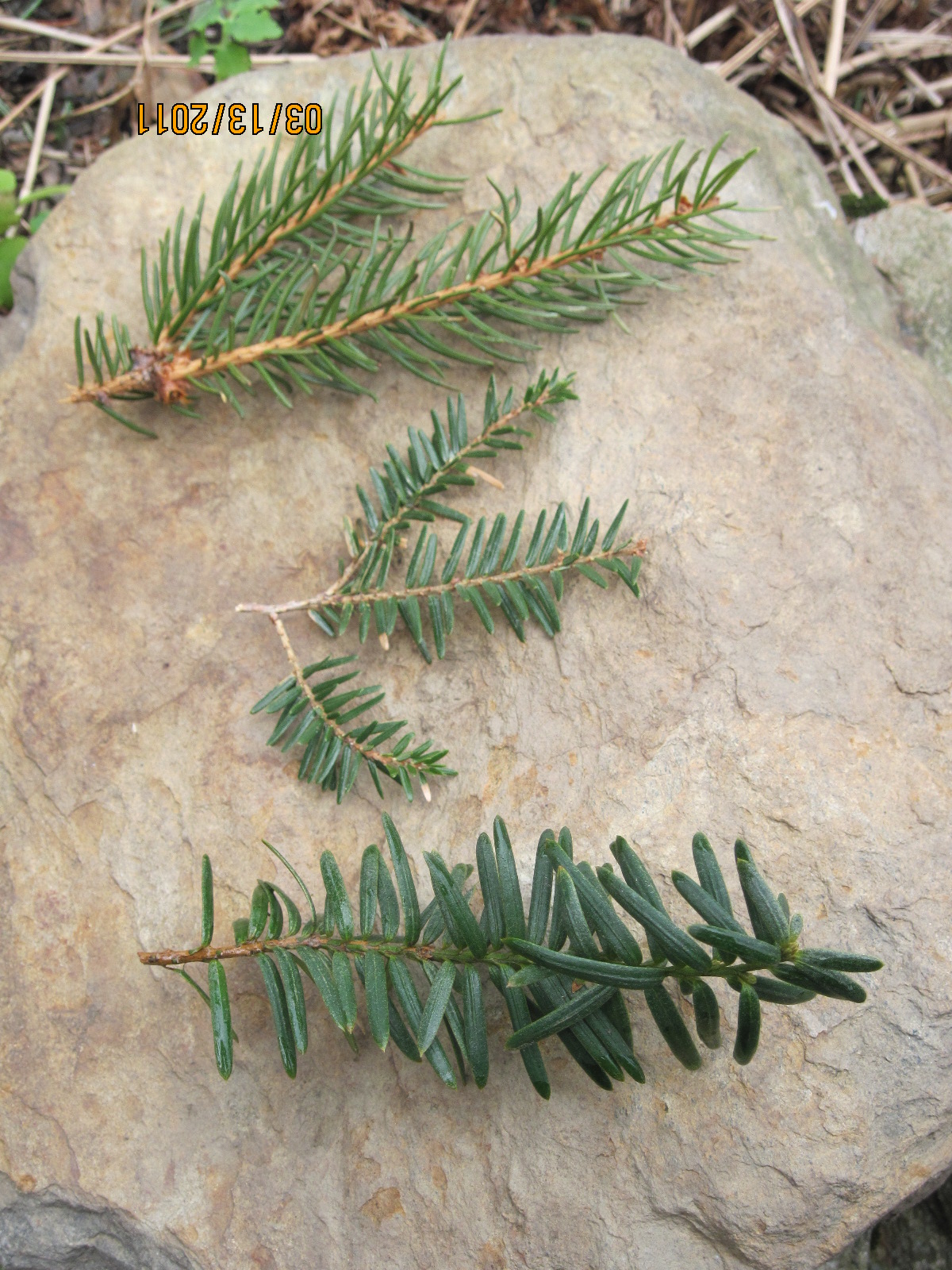
Fallen twigs from 3 different species of conifers.  From top to bottom:
Norway Spruce (Picea abies)
Canadian Hemlock (Tsuga canadensis)
 Yew, probably Japanese Yew (Taxus cuspidata)


An evergreen but definitely not a conifer, this rhododendron is a little 
worse for wear but doesn't look like it will take long to recover and 
start growing.

Sunday, April 25, 2010

Garden flowers


The garden that I act as "caretaker" has mainly perennials. This makes it lower maintenance than a garden that has to be largely replanted each year, but it risks becoming monotonous. Fortunately, there are enough different types of flowers to keep it colorful and varied throughout the majority of the growing season.

The first flowers in the garden every spring are the crocuses.


Crocuses usually come up in late March or early April here. They will push up through snow if there is still some on the ground. Since this spring got mild earlier than usual, they came up in the middle of March with no trace of snow to impede them. The flowers are unfortunately short-lived - after about a week they start looking kind of worn out and soon start dropping petals, and are pretty much gone less than three weeks after opening.

The second flowers to start opening are usually the anemones.
This plant usually continues producing new flowers until June or later.


Soon, the hyacinths make a dramatic appearance, with a whole clump of flowers opening simultaneously on a stalk rising from each plant.
The lawn grass is has been pushing into this flower bed for the last couple of years,
but the hyacinths don't seem to be bothered.

Hyacinths usually flower mid-April, but this spring they came up in early April, and the flowers are already fading in color and on their way out for the year.


The daffodils often are the very first plants to poke leaves out of the ground, before even the crocus. Unlike the crocus, though, they usually take a little while (maybe 3-4 weeks) after first rising from the ground to open their flowers.
A pleasant surprise - this group had only pure lemon-yellow flowers last year,
but this year one of the flowers has two distinct colors.

Some of the daffodils are shriveling already, while others probably have another month left. They seem to vary widely in terms of how long their flowers last.


Then, there are the tulips. I am seeing most of them for the first time in 3 years, because in the previous 2 springs they almost all got eaten by deer. The lot does not border directly on a wooded area - it's several hundred feet from the edge of the nearest woods - so the deer liked the tulips enough to walk through several peoples' yards at night to get a special treat. In some cases they ate the plant down to near ground level, but in other cases they waited until the flower was just about to open, and then ate just the flower and stem, which must be like the finest piece of chocolate to them. Finding these "decapitated" tulips was especially annoying.

This year, though, the deer haven't touched anything. Maybe the early spring meant more plants sprouting earlier in the forests so less need to forage in peoples' gardens. In any case, the tulips got a chance to flower again:
The pink and white striped ones in the middle photo were another pleasant surprise - I'm pretty sure that they were solid pink the last time they got a chance to flower. The stripes of various colors and patterns have an interesting history. These markings were especially prized by European tulip growers back in the 17th century. For a few years in the 1630s, breeding tulips became so lucrative in the Netherlands that tulip bulbs became a major investment vehicle, with single bulbs that produced flowers with unusual color combinations and patterns selling for the equivalent of several million dollars. This "tulipmania" collapsed, but tulips remained among the more prized flowers for the wealthy into the 19th century, when they finally became affordable to a larger public. Many attempts were made to crossbreed plants for seeds with more elaborate colors and patterns, but these almost always failed. Unbeknownst to early tulip-breeders, the stripes and multiple colors are not hereditary. They are caused by a viral infection that usually does not have any serious negative effect on the plant's health except to discolor the flowers. That's why a plant can go from solid-color flowers one year to striped and multicolored flowers the next year - it has been infected at some point. The fact that these diseased flowers happened to look more attractive to some people was just a lucky coincidence. Tulip growers discovered that the only way to reproduce a tulip with a desirable color and pattern was to wait for the main bulb to reproduce asexually by budding off smaller bulbs, and then separating these extra bulbs and replanting them. A tulip bulb in good soil will usually produce a number of clones in this fashion, so that rather than seeds became the main technique of tulip propagation.

Anyway, moving on from that hopefully not too dull mini-lecture, here is one of the next flowers to bloom, Dicentra spectabilis, the Bleeding heart:
Flowers slightly less than 1 inch (~2 cm.) from top to bottom.

Dicentra spectabilis is native to eastern Asia. It grows 2-3 feet tall and produces rows of fairly large, colorful, unusually shaped flowers by mid to late April. Unfortunately, as is the case with so many colorful perennials, the flowers have a limited life span. In less than a month, the flowers have mostly dropped. By late June, the plant's leaves and stems start to wilt and yellow in the summer heat, and by July I cut them back to the ground because the entire plant has turned a dead-looking yellow-brown. Ideally, a gardener should plant something that flowers later in the season alongside the bleeding heart so that something can take the plant's space in the garden when it dies back. I've tried a couple of things, but they haven't lasted more than a season.

In another part of the garden, there is a close relative of the bleeding-heart. This is Dicentra eximia. The garden has plants with both white and pink flowers. Dicentra eximia is a native of eastern North America (unlike most of the other plants in this post, which originate in various parts of Asia or Europe). It is only about 1 foot tall, and the flowers are proportionally smaller than those of Dicentra spectabilis, so it is much less showy. However, it has one major advantage - it stays green and keeps blooming throughout the entire growing season. It produces flowers from April through October, although there tend to be fewer later in the season.

Finally, some yellow Alyssum next to the front walkway. This plant is quite good at reseeding itself - it was originally planted in the garden some 20 years ago, and has grown in various parts of most of the different flower beds over time. It's a perennial, but the individual plants often die after a few years, to be replaced by their "children" growing nearby. The alyssum looks all but surrounded by various shrubs and trees, including the weeping cherry in the background.


Next - greenery and general views of the garden ....

Friday, April 23, 2010

Springtime pics

On a brighter note, the last two weeks have been extraordinarily colorful. Here are some pics from my Dad's yard/garden, which I basically act as a caretaker for. First, the trees. The weeping cherry peaked almost two weeks ago, when I took these photos:


Weeping cherry from two angles.


From underneath


Closeup of flowers


The other "tree" flowering now is a magnolia, but it is really more like a shrub.

Earlier this week, taken at the bottom of a slope -
it's actually barely taller than I am. Note the fading weeping cherry in the background.

Closeup of magnolia flowers.


These two trees are artificially bred varieties. There is at least one type of "wild" tree in the yard that puts on a nice display of flowering color - the red maple (Acer rubrum). Unlike most maples which rely entirely on wind to spread their pollen, the red maple uses the services of insects as well as the wind. Therefore, it produces colorful (though small) red flowers.

Red maple flowers almost 4 weeks ago.

Thousands of these small red flowers give the whole tree a distinct reddish tint that sets it apart from all other tree species in the area in the spring.

This sort of shows the reddish tint.

Red maples don't wait long after flowering to make their seeds. While other maples take until summer or fall to mature their seeds, the red maples have developed their seeds over the last 3 weeks or so, and will be ready to start dropping them all over the place come May.

The leaves are just coming out, but the seeds are almost mature.

As the red maples go through their accelerated flowering, seed development, and leafing out, the sugar maple (Acer saccharum) right next to them has barely started to poke either its leaves or flowers out. It won't drop its seeds until late summer or early fall. Still, time is ultimately on the side of the sugar maple, which on average grows taller and lives more than twice as long as the red maple.


Right: red maple; Left: sugar maple (ignore the pine behind it)

The sugar maple is the leading source of maple sugar (Duh!),
but you can get it from red maples as well - you just need a lot more sap
to get the same amount of sugar.

Next - Crocus, daffodils, tulips, and hyacinths; or, early spring flowers that aren't attached to trees and shrubs.

Sunday, March 21, 2010

Early taste of late spring

When I went outside Friday and yesterday, I had to remind myself repeatedly that this is the second half of March, not the second half of April or even the first half of May. The temperature was around 70 Fahrenheit (21 Celsius), which is quite a bit warmer than we would normally expect for March, which is a month where we can normally expect temperatures a good 15 or 20 degrees Fahrenheit (about 10 degrees Celsius) cooler. The preceding several days were not as warm, but still warmer than average.

Plants are clearly responding to this unusually early coming of warm springtime weather. Normally, I can expect to see crocus coming up at the very end of March or beginning of April, and the daffodils and tulips following shortly in early to mid April - though only the crocus blooms almost immediately after appearing. Yesterday, though:

Crocus - already blooming!


Tulips


Daffodils

And it isn't just the bulbs that seem are responding to the early warmth:

Some shrub - maybe some kind of honeysuckle?

The only snow I saw on a 3-mile walk was one pile of very dirty snow next to a school parking lot that had managed to hold out against over two weeks of rain and mainly above freezing temperatures:

Holdout snow pile, which is probably noticeably smaller today

Still, if you look really close at some of the trees in the background, you can see a slight tinge of red on some of them. That's a sign that they are red maples and that their first red flower buds are getting close to opening - probably some 2-3 weeks earlier than in an average year.

Now, what I'm really hoping for is that we don't get any long cold spells for the rest of the spring. Some plants can endure some real cold after they start growing leaves and flowers for the spring, others can't, and the latter will depend on the rest of the spring being free from serious cold spells.

I walked down a road that I haven't walked since last summer, and so from my point of view the plants weren't the only things that had seemingly appeared out of nowhere. A new building had risen from ground that supported only trees last year:

I could be wrong, but this building doesn't look like it will be particularly attractive
when finished. I'm not sure what it's going to be - the area around it is entirely residential, but it looks
more like a small office building to me.

Well, it's cooler today, but still pretty warm. By late in the week, it's supposed to be getting down to near freezing at night. Hopefully it won't stay much colder than that for an extended period of time. Also, even if the spring temperatures decide to act like this is Georgia or something - the summer temperatures had better not act like this is Georgia! Part of the bargain of living in a northern state, IMHO, is that you accept a colder and longer winter in return for not having to endure as long or as hot a summer.

Wednesday, March 17, 2010

Up early this year

A couple of days ago, I noticed something unexpected outside. The perennial bulbs are coming up out of the ground already - crocus, tulips, and daffodils. I don't think that I've never seen them poke above ground this early in the year before. Typically, the end of March or the beginning of April are more typical, especially for the daffodils and tulips, which tend to be a little bit behind the crocus.

Winter started out cold and snowy in December here, but for most of 2010 it has not been very severe at all. While places further south or further west and north got clobbered with very heavy snowfall, we've had little. There is almost no snow left now.

Hopefully there will NOT be a really cold spell now that the plants seem to be starting up early.

Wednesday, December 9, 2009

Let it snow

View out my bedroom window this morning

Since the start of work was delayed until after noon today due to snow, I just wrote about 6 paragraphs about how I grew up loving snow, but later came to think of it as a pain in the butt, but still appreciate how beautiful it can be. Then, when I was attempting to move the location of the picture, I somehow accidentally deleted everything that I had written - why doesn't blogger have a simple "Undo" icon?! I am not going to write all of it again, so I will sum up briefly -

- I loved snow as a child and missed it during a period where I lived in Louisiana.

- As I got older, snow became more of a burden and a lot less fun

- Unfortunately, it's not socially acceptable for a 34-year old man without kids to build snowforts or snowmen or throw snowballs around, so the stuff that I most enjoyed with snow as a kid is ruled out.

- Here in Massachusetts, snow often comes along with its siblings, sleet and freezing rain, which make life even more difficult than snow but with none of the side benefits.

- If only there were a way to keep the beauty of snow without all of the inconvenient part.

- Snow can be beautiful, but for my money it's not as beautiful as a good spring day.

A good spring day, by my reckoning