Showing posts with label flowers. Show all posts

Sunday, August 14, 2011

Flowers, fruit, insects

I haven't been posting many garden photos, mainly because the garden at my current residence is long on plants but relatively short on showy flowers (at least compared to the garden at my dad's house, which is where I took photos in previous years).  I've also been a bit negligent about taking photos in general this year.  Nevertheless, I 've managed to take some decent photos over the last 2-3 months.


Iris

Spiderwort (Tradescentia)

Roses (past their prime - I wish I had gotten a picture a few days before this).
Daylily (I don't know the different varieties - I just call them all daylilies).

Daylilies and Hosta in bloom together
More daylilies
A different variety of daylily near an ostrich fern
 Daylily closeup - can you tell that - 1. I like daylilies, and
2. Daylilies are some of the few large, colorful flowers in my garden?
Wild blackberries - various kinds of berries grow prolifically
(i.e., like weeds) in my current garden
Wild black cherries ripening
Dragonfly

Same dragonfly at a different angle
I've rarely seen an insect stay still for this long, which is
why I have so many photos of this dragonfly.
20 minutes later, what I think is the same dragonfly came back
and landed near me again - talk about a helpful subject!
A typical view of my semi-wild garden, with goldenrod starting
to flower on the left, and wild berries ripening to the right.

Tuesday, December 7, 2010

Random Garden Photos 2

I think that I should make this a regular feature over the course of the winter.  Hopefully other people will enjoy them, and I will get to look at some digital plants (and animals) that will partly make up for the lack of non-dormant plants outside now!

Honeybee on azalea flowers.


Pieris or Japanese Andromeda with new growth in the spring.
This variety has new growth that is red, which only gradually fades
to green by early summer.  To the left, a large hydrangea is just
starting to "leaf out".


Columbine hybrid with multiple layers of petals.

A perfect spring day in mid-May.  Scenes like this look especially beautiful
after month after month of drab, dormant ground in winter and early spring.

Saturday, November 27, 2010

Removing fences and flowering cacti: a random post

Clearing leaves and dead perennial foliate did not complete in the garden this year. There was also the question of the old wooden fence that my parents put up partway around an above-ground pool back when we were kids. The pool was long since taken down and replaced by more gardening space, but the fence remained. Over the last few years, it has been showing its age, so my father wanted to take it down.

This is what we ended up with. The wooden pieces are gone, the
metal poles embedded in concrete bases that we dug out of the ground
are still here for the moment.

This is the garden area and part of the fence in the summer (the rest of the
fence bends back and is hidden behind the front part):
Here's a more closeup view of the same area after we were finished taking
the fence down:
The fence ran through the garden area in the lower part of the picture.

This shouldn't be much of a problem for the plants - only a couple of them were climbers, and we can get trellises for those. Almost all of them were basically sun rather than shade plants - the extra sun from the removed fence should help them or at least not hurt them.

This picture inserted for no good reason other than that I think
that as many posts as possible should have pictures taken just after sunset.

Meanwhile, there are actually plants growing inside the house as well. They rarely get the attention that they deserve in this blog, but I couldn't ignore the Christmas cactus, which started blooming a little earlier than its name would suggest, but at the right general time of year.
Top-down view

In my humble opinion, Christmas cacti have some of the most beautiful flowers around. They look incredible close up:


Monday, June 14, 2010

Yet more garden photos


One of these days, I'll make a post that requires more thought, but for now, more garden photos will have to so ...

Here you can make out yellow Coreopsis in bloom in the center, and several foxgloves
with their long spikes of purple flowers above then and further from the camera


A self-seeded Rose Campion (Lychnis coronaria) with small magenta-colored flowers
is growing on what should be the walkway to the left of center near the bottom of the picture. I decided not to pull it up because I have a general policy of not removing nice flowers that are kind enough to grow without even being deliberately planted.


Self-seeded foxgloves (Digitalis purpurea, I think)


Hostas with a Japanese painted fern kind of squashed between them


Common Milkweed (Asclepius syriaca) - another self-seeded plant, and a native. As the name implies, it is generally considered a weed, but IMHO it's a pretty and not-terribly-aggressive one that is conveniently filling in a spot that was bare before, so I decided that it's welcome. Behind it is a large clump of Oregano - first planted a decade ago by mom as a source of fresh spices, it quickly spread far beyond our puny needs for cooking, and now there are probably 15 clumps of it growing in various parts of the flower beds, which need to be partly torn out every year of two to prevent them from pushing out neighboring plants. It stays from a combination of my inertia and the fact that the flowers, while tiny, attract lots of insects, including butterflies and occasionally some odd orange and iridescent blue-colored hornets that I have never seen near any other flower in the garden.

Saturday, May 8, 2010

Tulips and other flowers of mid-spring

I was so happy to see the tulips actually get a chance to bloom this year instead of being eaten by deer that I took lots of photographs. There are plenty of other flowers that have been blooming over the past 10 days or so, and I didn't completely neglect them with the camera.

First, the tulips. Most of these photos were actually taken last weekend. Unfortunately, tulips are not very long-lasting flowers once they open, and virtually all of the flowers pictured here have dropped all of their petals. Today I clipped off a lot of the flower heads, because bare flower heads after the petals fall off look rather unattractive (in my opinion), plus if they actually produce seeds, this will use some of the sugar and other nutrients that the plants live on. If they don't produce seeds, more of the nutrients will go down into the bulb, resulting in a larger plant next year. Or so I've heard - I probably should check more closely to see if I'm wasting my time!

These first two pictures are two views of the same tulip. It is the only one with this color combination in the garden - I especially like the combination of colors when the flower is backlit.


Red and white striped tulip with colors that remind me of a candy cane. (It doesn't take much to remind me of one kind of junk food or another.) These I like how the outer "petals" flare out like little tongues. (The "outer petals" are actually sepals in tulips. For many kinds of flowers, the sepals are the green lobes that make up the outer covering of the flower before it opens, and which usually shrivel up or become inconspicuous after the flower opens and the petals come out. In tulips, however, the sepals change color to match the petals as the flower starts to open, and remain an important part of the flower until they drop off around the same time as the petals.)


Pinkish tulip with a lighter central area and sepals that flare out somewhat less than the previous flower.


Large yellow tulip with dark center - and a small spider crawling on the right side.


A tulip of the same type as the previous, except with a single red stripe.


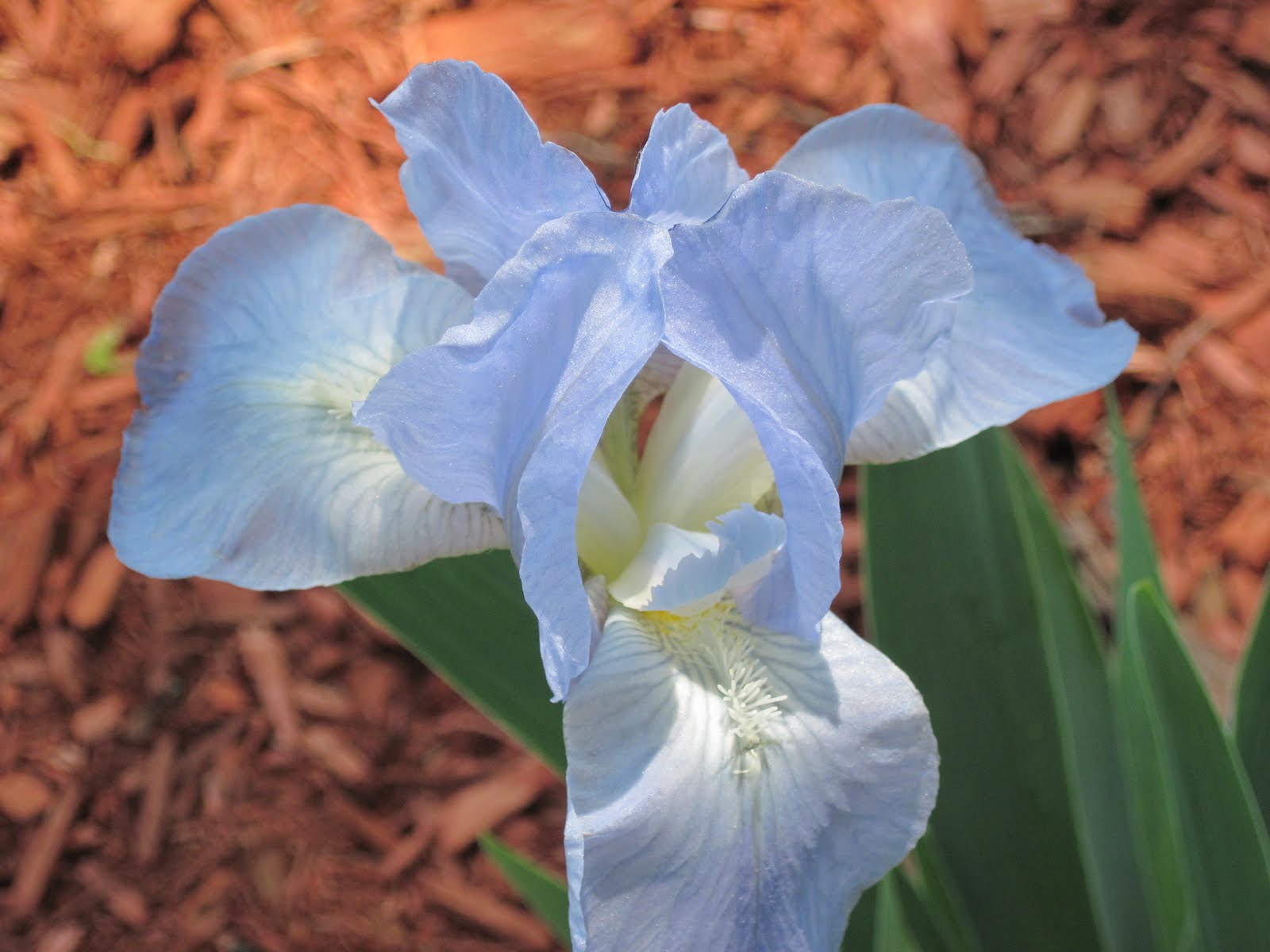
Some type of pale blue iris - as you may have noticed, I'm not good at remembering the names of different varieties or cultivars! All I know is that I got this at a local garden club sale, and that it is a short variety, with the the flowers no more than 6-8 inches above the ground and the leaves not much taller.


A closeup of the flowers of an azalea or dwarf rhododendron (I can't remember which) in front of the house. Notice the bee at work gathering nectar from the flower in the center - I believe this is a honey bee.

A broader view of the same azalea along the walkway to the front door of Dad's house (the house where I spent most of my childhood and have lived for some of my adult years as well.)


A cluster of pink tulips, with some white and red tulips in front of them (kind of washed out from the late afternoon sunlight glaring off the white flowers). The pale blue irises are at upper left, further from the camera than the tulips - you can see how they are pretty short.


An azalea bush with reddish flowers to the left, pink and mixed pink and white tulips to the right. There are a mix of lower-growing plants, including a few blue anemones to the left, a few purplish grape hyacinths to the right, the plant with the gray-colored foliage whose name I can never remember, and a bunch of lily-of-the valley sprouting just about everywhere it can. (Lily of the Valley spreads itself all too well by underground runners. Mom planted it years ago against her better judgment in a location a few feet to the left of the left edge of this photo, and surrounded it with a plastic barrier 6 inches deep to prevent it from spreading as recommended in the garden books. This worked for 2 or 3 years, but then its underground runners found some little breach and it has been spreading to a wider part of the garden each year.)


A patriotic grouping of flowers - red azalea bush, white candytuft (Iberis sempervirens), and blue anemones.


A nice ensemble photo, with 5 colors of tulip (multiple pinks and purples, 2 white with a little red, and a single solid red and single pale-pink/yellow) growing along with bleeding hearts (background), candytuft (lower left), and yellow alyssum (right). An azalea bush is just above the alyssum, but this one has not started to flower yet.


Pink, purple, and red tulips again, along with bleeding hearts and alyssum, and the pale blue irises (which were hidden behind another some of the tulips in the previous picture.)

Sunday, April 25, 2010

Garden flowers


The garden that I act as "caretaker" has mainly perennials. This makes it lower maintenance than a garden that has to be largely replanted each year, but it risks becoming monotonous. Fortunately, there are enough different types of flowers to keep it colorful and varied throughout the majority of the growing season.

The first flowers in the garden every spring are the crocuses.


Crocuses usually come up in late March or early April here. They will push up through snow if there is still some on the ground. Since this spring got mild earlier than usual, they came up in the middle of March with no trace of snow to impede them. The flowers are unfortunately short-lived - after about a week they start looking kind of worn out and soon start dropping petals, and are pretty much gone less than three weeks after opening.

The second flowers to start opening are usually the anemones.
This plant usually continues producing new flowers until June or later.


Soon, the hyacinths make a dramatic appearance, with a whole clump of flowers opening simultaneously on a stalk rising from each plant.
The lawn grass is has been pushing into this flower bed for the last couple of years,
but the hyacinths don't seem to be bothered.

Hyacinths usually flower mid-April, but this spring they came up in early April, and the flowers are already fading in color and on their way out for the year.


The daffodils often are the very first plants to poke leaves out of the ground, before even the crocus. Unlike the crocus, though, they usually take a little while (maybe 3-4 weeks) after first rising from the ground to open their flowers.
A pleasant surprise - this group had only pure lemon-yellow flowers last year,
but this year one of the flowers has two distinct colors.

Some of the daffodils are shriveling already, while others probably have another month left. They seem to vary widely in terms of how long their flowers last.


Then, there are the tulips. I am seeing most of them for the first time in 3 years, because in the previous 2 springs they almost all got eaten by deer. The lot does not border directly on a wooded area - it's several hundred feet from the edge of the nearest woods - so the deer liked the tulips enough to walk through several peoples' yards at night to get a special treat. In some cases they ate the plant down to near ground level, but in other cases they waited until the flower was just about to open, and then ate just the flower and stem, which must be like the finest piece of chocolate to them. Finding these "decapitated" tulips was especially annoying.

This year, though, the deer haven't touched anything. Maybe the early spring meant more plants sprouting earlier in the forests so less need to forage in peoples' gardens. In any case, the tulips got a chance to flower again:
The pink and white striped ones in the middle photo were another pleasant surprise - I'm pretty sure that they were solid pink the last time they got a chance to flower. The stripes of various colors and patterns have an interesting history. These markings were especially prized by European tulip growers back in the 17th century. For a few years in the 1630s, breeding tulips became so lucrative in the Netherlands that tulip bulbs became a major investment vehicle, with single bulbs that produced flowers with unusual color combinations and patterns selling for the equivalent of several million dollars. This "tulipmania" collapsed, but tulips remained among the more prized flowers for the wealthy into the 19th century, when they finally became affordable to a larger public. Many attempts were made to crossbreed plants for seeds with more elaborate colors and patterns, but these almost always failed. Unbeknownst to early tulip-breeders, the stripes and multiple colors are not hereditary. They are caused by a viral infection that usually does not have any serious negative effect on the plant's health except to discolor the flowers. That's why a plant can go from solid-color flowers one year to striped and multicolored flowers the next year - it has been infected at some point. The fact that these diseased flowers happened to look more attractive to some people was just a lucky coincidence. Tulip growers discovered that the only way to reproduce a tulip with a desirable color and pattern was to wait for the main bulb to reproduce asexually by budding off smaller bulbs, and then separating these extra bulbs and replanting them. A tulip bulb in good soil will usually produce a number of clones in this fashion, so that rather than seeds became the main technique of tulip propagation.

Anyway, moving on from that hopefully not too dull mini-lecture, here is one of the next flowers to bloom, Dicentra spectabilis, the Bleeding heart:
Flowers slightly less than 1 inch (~2 cm.) from top to bottom.

Dicentra spectabilis is native to eastern Asia. It grows 2-3 feet tall and produces rows of fairly large, colorful, unusually shaped flowers by mid to late April. Unfortunately, as is the case with so many colorful perennials, the flowers have a limited life span. In less than a month, the flowers have mostly dropped. By late June, the plant's leaves and stems start to wilt and yellow in the summer heat, and by July I cut them back to the ground because the entire plant has turned a dead-looking yellow-brown. Ideally, a gardener should plant something that flowers later in the season alongside the bleeding heart so that something can take the plant's space in the garden when it dies back. I've tried a couple of things, but they haven't lasted more than a season.

In another part of the garden, there is a close relative of the bleeding-heart. This is Dicentra eximia. The garden has plants with both white and pink flowers. Dicentra eximia is a native of eastern North America (unlike most of the other plants in this post, which originate in various parts of Asia or Europe). It is only about 1 foot tall, and the flowers are proportionally smaller than those of Dicentra spectabilis, so it is much less showy. However, it has one major advantage - it stays green and keeps blooming throughout the entire growing season. It produces flowers from April through October, although there tend to be fewer later in the season.

Finally, some yellow Alyssum next to the front walkway. This plant is quite good at reseeding itself - it was originally planted in the garden some 20 years ago, and has grown in various parts of most of the different flower beds over time. It's a perennial, but the individual plants often die after a few years, to be replaced by their "children" growing nearby. The alyssum looks all but surrounded by various shrubs and trees, including the weeping cherry in the background.


Next - greenery and general views of the garden ....