I'm currently reading a fairly short book about the possibilities of extraterrestrial life (The Eerie Silence: Renewing Our Search for Alien Intelligence, by Paul Davies. Boston, New York, Houghton Mifflin Harcourt, 2010). I just reached a section that especially got my attention, even though it's only tangentially connected to the question of extraterrestrial intelligence. As Davies discusses the various things that would have to happen in order for intelligent extraterrestrial life capable of communicating with humans to exist, he also discusses what we know about how modern human civilization emerged on earth. When he reaches the question of the development of modern science and technology (which would be necessary for any intelligent civilization to communicate over very long distances), he discusses the prerequisites for the development of the scientific method in human civilization over the past few centuries, and it is here that he gives what I'm sure is a fairly controversial opinion.
It is certainly fashionable, partly for reasons of political correctness, to assert that, here on earth, any human society would be bound to discover science and technology in the fullness of time. To say otherwise seems to be implying the superiority of European civilization, where science as we know it began, and this is regarded by some people as racist and chauvinistic. Personally, I have always been sceptical of the claim that 'science is inevitable'. The problem is that science works so well, and is so much a part of everyday life, that people tend to take it for granted. ... The 'obvious' view of science is seen to rest on flimsy foundations when placed in a historical context, however. Science proper emerged in Renaissance Europe under the twin influences of Greek philosophy and monotheistic religion. The Greek philosophers taught that humans could come to understand the world by the exercise of reason, which achieved its most disciplined form in the rules of logic and the mathematical theorems that followed therefrom. They asserted that the world wasn't arbitrary or absurd, but rational and intelligible, even if confusing and complicated. However, Greek philosophy never spawned what today we would understand by the scientific method, in which nature is 'interrogated' via experiment and observation, because of the Greek philosophers' touching belief that the answers could all be deduced by pure reason alone. The Greeks' remarkable advances in reason and mathematics were nurtured for centuries during the European Dark Ages by Islamic scholars, without whom it is very doubtful that science and mathematics would have taken root in European culture in medieval times. An echo of the Islamic phase survives in modern terms like algebra and algorithm, and in the names of familiar stars such as Sirius and Betelgeuse. In spite of the importance of the Islamic phase in the lead-up to science, for some reason (possibly political or social) Arab scholars did not go on to formulate mathematical laws of motion or carry out laboratory experiments in the modern sense of the term. (Paul Davies, The Eerie Silence, p. 72-73)
There is another influence besides the rationalism of ancient Greek philosophers that Davies believes was essential to the development of modern science, however. This is monotheistic religion - a surprise given the modern disputes between monotheistic religion and science.
Meanwhile, monotheism increasingly shaped the Western world view during the formative stages of science. Judaism represented a decisive break with almost all contemporary cultures by positing an unfolding cosmic narrative based on linear time. According to the Judaic account, the universe was created by God at a definite moment in the past, and developed in a unidirectional series (creation, fall, trials and tribulations, Armageddon, salvation, judgement, redemption ...). In other words, Judaism has a cosmic story to tell, of a divine plan revealed through historical sequence. This was in sharp contrast to the prevailing view that the world is cyclic: the rotation of good times and bad times, the rise and fall of civilizations, the revolving wheel of fortune. Even today, the unidirectional linear-time world view of Western civilization rests uneasily with other cultural motifs, such as the dreaming of the Australian Aborigines or the cyclicity of Hindu and Buddhist cosmologies.
The concept of linear time, and a universe created by a rational being and ordered according to a set of immutable laws, was adopted by both Christianity and Islam, and was the dominant influence in Europe at the time of Galileo. The early scientists, who were deeply religious, regarded their work as uncovering God's plan for the universe, as revealed through hidden mathematical relationships. What we now call the laws of physics they saw as thoughts in the mind of God. Without belief in a single omnipotent rational lawgiver, it is unlikely that anyone would have assumed that nature is intelligible in a systematic quantitative way, mirrored by eternal mathematical forms. The scientific method itself verged on being an occult practice at the time of Newton, and was conducted after the fashion of a secret society. Writing coded symbols on pieces of paper and subjecting matter to 'unnatural' experimentation in the sanctum of special laboratories is an arcane procedure by any standards. So science, though considered natural enough today, was little different from magic when it was first established. (Davies, p. 73-74)
Davies is pretty sure, in fact, that no other civilization besides early modern Europe had the intellectual tools to come up with the scientific method - even civilizations that were just as technologically advanced.
Suppose an asteroid had hit Paris in 1300 and destroyed European culture. Would science ever have emerged on Earth? I have never heard a convincing argument that it would. It is often remarked that in medieval times the Chinese were technologically far more advanced than the Europeans, which is true. So why did the Chinese not go on to become true scientists? Part of the reason is that traditional Chinese culture was not steeped in the monotheistic notion of a transcendent lawmaker. Outside the monotheistic world, nature was perceived as ruled by the complex interplay of competing influences in the form of gods, agents and concealed mystical tendencies. In medieval China, no clear distinction was drawn between moral laws and laws of nature. Human affairs were inextricably bound up with the cosmos, forming an indivisible unity. For the pagans of Europe and the Near East, who were in competition with Christianity and Islam at their formative stages, knowledge of the cosmos was to be gained through 'gnosis', a mystical communion with the creator, rather than through rational enquiry. Could gnosis eventually lead to science? I don't think so. Unless you expect there to be an intelligible order hidden in the processes of nature - fixed and analysable by mathematics - there would be no motivation to embark on the scientific enterprise in the first place. (Davies, p. 74)
I suspect that Davies' claims would strike many people as being culturally chauvinist, as he noted himself. Is there any historical evidence that could be used to show that they are true or false? History is notoriously inexact and unclear compared to the physical sciences, and there is no way of applying the strict experimental method to history ("... in group B, we will eliminate European civilization in 1300 CE and compare the rate of development of a scientific worldview with the control group that includes European civilization ..."). Still, there might be some way of evaluating these claims in a very limited way ....
(In the near future, I'll give my off-the-cuff evaluation ...)
Sunday, June 6, 2010


Thursday, June 3, 2010
Plants and history
I love history, and I love botany, so I especially like reading about plants in human history. Here's a few odd facts and stories that I've learned about a few local plants over the years, illustrated with a few of my own photos.
 White Pine (Pinus strobus)
This conifer can grow to be the tallest tree in eastern North America, with some specimens in the old-growth forests of colonial times supposedly topping 200 feet (about 60 meters) in height. The large size, plus the wood's combination of strength, softness, flexibility, and low amount of resin (for a pine) made it ideal timber for some uses. The trunks of larger specimens were used for ship masts because they were strong but could flex when under great strain. The largest trees of all were officially reserved for use by the British navy in colonial times, and were sometimes branded with a symbol that marked them as so-called "King's pines" (reserved for use of the King's navy). The fact that they weren't allowed to cut them for their own ships or other use was another in the accumulating list of grievances that the colonists of New England developed against the British government.
By the later 19th century, most of the old-growth white pines had been logged, but the white pine certainly didn't become a rare species. The trees adaptability to a variety of conditions and fast growth rate meant that it was often the most common tree to grow on farm fields that had been abandoned. By the late 19th century, a lot of farms in New England were being abandoned as many farmers moved to land in the midwestern and great plains states that had richer soil with fewer rocks, or else moved into the towns and cities to find more profitable work. By the early 20th century, a second wave of logging swept over New England, cutting down the second growth of white pines for a new use - shipping crates. It turned out that white pine wood was ideal for making crates for shipping a wide variety of items by rail, ship, and truck - and the trees didn't have to be especially big to furnish timber for crates.
By the mid 20th century, the development of cardboard among other things undercut the market for white pine crates, and the pines regrew a third time. Some of the pines and other trees of this third generation of New England forests since European colonization have been cut down in their turn for housing developments and malls and other features of suburban sprawl, but many remain because suburban sprawl actually involves less clearing of land than the farming and lumber industry of earlier time. Today, Massachusetts has far more forested land than it did at the time of the American Revolution - though hardly any of it is fully mature old growth forest. Perhaps at least some of it will be able to grow uncut for centuries and allow some of the relatively young 50 or 60 foot tall white pines common today to grow to the 150, 175 or even 200 foot giants that were once far from rare.
The white pine has also been a symbol for both Native American nations and the European-descended whites who displaced them. The Haudenosaunee or Iroquois people who lived in what later became New York State used a white pine as a symbol on their modern flag, which is based on much older designs. For the Haudenosaunee, the white pine represented peace and the unity of the several nations who united to form a confederacy. One possible reason for this symbolism is that the white pine grows its needles in bunches of five, and the original Haudenosaunee or Iroquois confederation was made up of five nations (a sixth joined later).
When the English settled in New England, the white pine became a symbol for them as well, as the pine tree flag used during the American Revolution indicates.

Europeans introduced many terrible diseases to the natives of North and South America, but America only gave the "old world" a single significant disease in return - syphilis. Still, it became common enough in Europe during the 16th century that Europeans were desperate to find a cure. One theory was that since the disease came from the Americas, only a plant from the Americas could provide an appropriate remedy. A number of different plants from different parts of the American continents were tried, none with much success. One of the most popular plants that was tried was the sassafras tree, a native of much of what is now the eastern USA. Some of the very first Europeans to land on the coast of what later became New England at the beginning of the 17th century - more than a decade before the Pilgrims who settled at Plymouth- came primarily to cut down Sassafras trees and dig up their roots to extract the oil. Both the fruit and the roots could be used to produce an oil that had painkilling properties (this was probably where it got the reputation of being a good "cure" - for most infectious diseases at the time, the best treatments alleviated the symptoms rather than helping much with the disease itself). The oil also had a distinctive smell that many found attractive and that repelled insects to boot. Settlers later found that parts of the plant could also be used to make flavorful teas and a distinctively flavored beer known as "root beer" because the extract that gave it a distinctive taste came from Sassafras tree roots (yes, the original root beer was an actual beer).
Unfortunately, parts of the sassafras plant also contain the chemical safrole, which is potentially carcinogenic. Not surprisingly, sassafras isn't used for medical treatment anymore, but dried and ground leaves (which don't contain significant amounts of safrole) are used as a seasoning in some regional American cuisines, especially cajun and creole in Louisiana.
 Grapevine (Vitis genus, unknown species)
European explorers overseas often looked for evidence of something familiar as they surveyed an unfamiliar environment, and in North America one familiar thing that they often saw was grapevines. One Viking saga tells of how Norse explorers who reached North America around 1000 AD found grapevines there, but did not recognize them because they did not grow in their own homelands of Scandinavia, Iceland, or Greenland. Instead, it was a servant who originally came from the Rhineland of Germany and who was familiar with grapes who recognized the American grapevines and pointed them out to Norse fellow explorers. There is some controversy about this legend, because the only place in North America where the Vikings are known to have landed is northern Newfoundland, which was too far north for grapevines to grow even during the unusually warm early medieval period when the Norse crossed the north Atlantic. One possible explanation is that the medieval Norse word for "grapes" might also refer to other kinds of berries that did grow in Newfoundland. Another possibility is that the Vikings set up a base in Newfoundland, but explored much further south, reaching Quebec, Nova Scotia, New Brunswick, and possibly parts of New England. In these places, they would have found plenty of native grapevines. What is certain is that when Europeans returned in larger numbers to temperate North America in the 16th and 17th centuries, many of them remarked on the grapevines. Giovanni da Verrazzano, leading one of the first European expeditions to explore what is now the eastern coast of the USA in 1524, noted:
We noticed many wild grapevines climbing up the trees, as they do in the north of Italy
In fact, North America has a larger number of grape species than any other part of the world. In spite of this biological diversity, and in spite of Verrazzano's optimistic prediction, none of these species have ever been able to rival Vitis vinifera, the old world grape native to the Mediterranean, as a source of either wine or table grapes. Still, the native grape species Vitis labrusca, Vitis riparia, and Vitis rotundifolia have all been developed into several varieties of wine and table grapes, even if they will never match the traditional V. vinifera in popularity.
 Virginia spiderwort (Tradescentia virginiana)
This plant was one of the first native plants of North America to be brought back to Europe for mainly aesthetic reasons - as a garden plant. It was introduced to England by John Tradescant the Younger, a 17th century English scholar and botanist who served as chief gardener to King Charles I of England and who personally traveled to Virginia in the 1630s to find interesting plants for the gardens of the King and wealthy English nobles.


This plant is a common weed in fields, lawns, and roadsides in the northeastern United States. It also was (and is) a common weed in Europe, and this weediness lies at the root (no pun intended) of its spread to North America. Because it was a common weed in fields of wheat and other grains, its seeds inevitably got mixed in with seeds of wheat and barley and forage grasses that the early settlers took with them from Europe to sow in their new fields in what became the eastern USA and Canada. Wheat, barley, and other plants were sown, the seeds of the common plantain were unwittingly sown with them. A number of other weeds came over from Europe with European settlers in the same manner - the best known of these is probably the common dandelion. The common plantain, though, became so common around English settlements that the Native Americans in New England took a special notice of it. They referred to it by a phrase which translates as "the white man's foot", because they said that wherever white settlers went, this plant, unknown before they came, seemed to appear almost as if by magic.
Tuesday, June 1, 2010
Re: my posts
Sorry that I haven't been posting much besides garden and plant stuff lately. I haven't been feeling at my best mentally, I've felt tired a lot, and gardening and plants are the only things that have both made me both want to write and that I feel like I can write (semi-) coherently about. Every time I want to write something about history, my life, or some other issue, I start worrying if my post really is worthwhile or makes any sense or is pointless or will unnecessarily offend someone, or whether it accurately represents what I am really thinking, etc., etc. Frankly, I didn't start blogging to add another pointless obsessive self-imposed emotional burden to my life, so I avoid posting except for the few subjects that are free of this emotional baggage. (Given my talent for creating pointless self-imposed emotional burdens, I shouldn't be so surprised that this has happened.)
The same issue applies to a certain degree commenting on other peoples' blogs.
Hopefully this will pass.
The same issue applies to a certain degree commenting on other peoples' blogs.
Hopefully this will pass.
Saturday, May 29, 2010
Tulip tree
The first time I remember seeing a tulip tree (Liriodendron tulipifera) was during a family trip to Virginia. I didn't think that it grew as far north as Massachusetts. I was quite wrong. It's far from common, but it is occasionally planted as a landscape tree, and can survive. When I started at my current job a couple of years ago, I realized when spring came that there was a big specimen growing right next to the parking lot.
 It's impossible to fit the whole tree into one picture from the parking lot.
The tulip tree, aka yellow poplar, is a native of much of the United States east of the Mississippi, more common in the southeast but obviously capable of growing as far north as Massachusetts - though we are on the extreme northern edge of its range. It's a very distinctive and remarkable tree. In sheer size, it can be one of the largest trees in eastern North America, growing to more than 160 feet/50 meters tall in the more southern parts of its range. The leaves, flowers, and seeds are very distinctive and not easy to mistake for anything else once you get a close look at them.
The most distinctive feature of all, and the one that gives the tree its name, are the flowers. They are large and showy, a mixture of yellow, orange, and green, and shaped somewhat like tulips - hence the name for the tree. Unfortunately, the flowers tend to be mostly on the middle and upper branches of the tree, so it can be difficult to get a good closeup, especially on a fairly large tree.
 Tulip tree flowers - pale yellow and orange in color
The name for the tree may come not only from the shape of the flowers themselves, but also from the shape of the leaves. They have a similar shape to the outline of some types of tulip flowers when seen from the side. They also look a little like maple leaves, but they have 4 lobes rather than the 5 or 3 lobes that maple leaves have. Tulip tree leaves lack a middle lobe of the type that gives maple leaves a "tip" in the center.
 Closer view of Tulip tree leaves - 4 lobes total, no central lobe
 Closer view of Tulip tree leaves - 4 lobes total, no central lobe
Tulip trees are related to magnolias, but they have no really close relatives (in the same genus) in North America. Their closest relative is in fact a native of China - Liriodendron chinense. It may seem bizarre that the closest relative of a plant native to the eastern USA is found in China, on the opposite side of the northern hemisphere, but in fact many plants from both eastern and western North America have close relatives in China and other parts of eastern Asia. For tens of millions of years, the two continents have apparently been exchanging plant and animal species through several different means - dry land bridges or bridges of closely-spaced islands caused by either lower sea levels or geological activity, or by migrating birds and wind-blown seeds. In the distant past, tens of millions of years ago, it was also apparently easier for Asia and North America to exchange plant species because the world's climate was both warmer and wetter, so even the high arctic latitudes where the two continents came closest too each other were covered with temperate or even subtropical forests, rich in plant species that could migrate in both directions. In more recent times, the two continents have been temporarily joined by a land bridge during ice ages, but that land bridge was frigid tundra, which allowed animals - including humans - to move between the continents, but was only useful to plants that were adapted to the coldest tundra conditions - which eliminates most trees!
Saturday, May 22, 2010
Garden geography
One of the things that I find interesting about gardening is something that many gardeners probably don't think very much about - where the plants in the garden originally came from. Most garden plants, whether flowers, herbs, or vegetables, have been selectively bred to some degree to produce larger flowers or leaves or roots, but most of them still have a lot in common with their wild ancestors. So, in a sense, even an average suburban garden is a sort of herbarium or botanical garden with specimens that originate in various parts of the world. Here are just a few samples from my particular garden:
 Dicentra eximia - Wild bleeding heart; native to
eastern United States, mainly Appalachian mountains
 Syringa vulgaris - Common lilac; native to the
Balkan peninsula of southeastern Europe

 Podophyllum peltatum - Mayapple; native to
eastern United States
 Cercis canadensis - Eastern redbud; native to
eastern United States (but not Canada, in spite of the name)
 Centaurea cyanus - Cornflower or Bachelor's button; native to
most parts of Europe
 Rosa carolina - Pasture rose or Carolina rose; native
to eastern United States and southeastern Canada
 Rudbeckia hirta - Black-eyed susan; native to
central and eastern United States and Canada
 Athyrium niponicum - Japanese painted fern; native to
Japan (duh!), northern China, Korea, Taiwan
 Leucanthemum x superbum - Shasta daisy; hybrid of two species
native to Europe -- with Apis mellifera - Honey bee; native to parts of Asia,
Africa, and Europe
 Dicentra spectabilis - Bleeding heart or Lyre-flower; native to
southeastern Siberia, northern China, Korea, and Japan

 Rhododendron maximum - Great rhododendron; native to
eastern United States and southeastern Canada
You may notice that all of these plants are natives of either eastern North America, Europe, or the northern China-Korea-Japan area. This isn't an accident - the northeastern part of the United States has a type of climate sometimes known as humid continental. There are three large areas of land on earth that have this climate:

Image from here on Wikipedia - see this article.
The native ranges of most of the common (and quite a few of the less common) garden plants that grow in the northeastern United States fall mostly within one of these three zones.
 Dicentra eximia - Wild bleeding heart; native to
eastern United States, mainly Appalachian mountains
 Syringa vulgaris - Common lilac; native to the
Balkan peninsula of southeastern Europe

 Podophyllum peltatum - Mayapple; native to
eastern United States
 Cercis canadensis - Eastern redbud; native to
eastern United States (but not Canada, in spite of the name)
 Centaurea cyanus - Cornflower or Bachelor's button; native to
most parts of Europe
 Rosa carolina - Pasture rose or Carolina rose; native
to eastern United States and southeastern Canada
 Rudbeckia hirta - Black-eyed susan; native to
central and eastern United States and Canada
 Athyrium niponicum - Japanese painted fern; native to
Japan (duh!), northern China, Korea, Taiwan
 Leucanthemum x superbum - Shasta daisy; hybrid of two species
native to Europe -- with Apis mellifera - Honey bee; native to parts of Asia,
Africa, and Europe
 Dicentra spectabilis - Bleeding heart or Lyre-flower; native to
southeastern Siberia, northern China, Korea, and Japan

 Rhododendron maximum - Great rhododendron; native to
eastern United States and southeastern Canada
You may notice that all of these plants are natives of either eastern North America, Europe, or the northern China-Korea-Japan area. This isn't an accident - the northeastern part of the United States has a type of climate sometimes known as humid continental. There are three large areas of land on earth that have this climate:
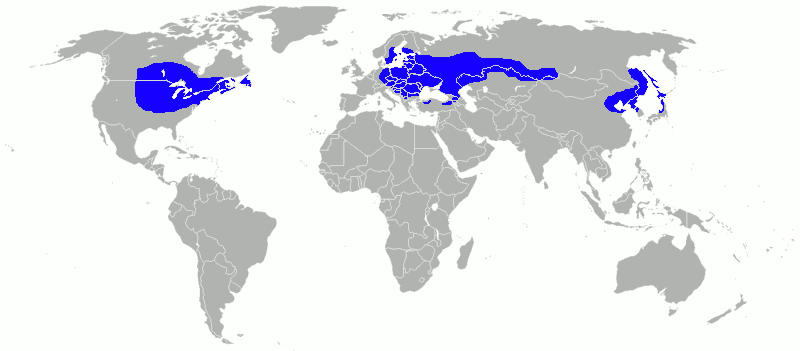
Image from here on Wikipedia - see this article.

The native ranges of most of the common (and quite a few of the less common) garden plants that grow in the northeastern United States fall mostly within one of these three zones.
Wednesday, May 19, 2010
Tired
Tired at all hours of the day. Tired enough to barely keep my eyes open sometimes. Tired enough to go in and out of a near-sleep state in front of my computer at work, in which my eyes are open but I am not conscious of my surroundings. Tired for no apparent reason. Tired in spite of getting enough sleep. Tired in spite of not being particularly stressed. Tired in spite of not feeling sick in any other way. Mystery tired. Not too worried - it happens occasionally. Hope it goes away.
Monday, May 10, 2010
Wild turkey
As I was eating breakfast this morning, I saw a wild turkey in the backyard right outside the window, less than 10 feet away. By the time I got my camera, it was further away but I managed to get a couple of good photos:


 I'm pretty sure this was a female - the males are considerably larger and have more reddish skin on their head and neck. They can fly, but only do so when they really have to, preferring to walk around. They often travel in groups, but this one was solitary.
Twenty years ago, wild turkeys were very rare in this part of Massachusetts, having been hunted or driven out by the 19th century. The first one in my town in more than 100 years was spotted 18 or 20 years ago. Now they are common enough that it's no surprise to see them, but this was still an unusually good opportunity to get a picture from pretty close up in good light - and from indoors, where my movement and noise wouldn't drive the bird away quickly.
Subscribe to:
Posts (Atom)