Saturday, May 8, 2010

Tulips and other flowers of mid-spring

I was so happy to see the tulips actually get a chance to bloom this year instead of being eaten by deer that I took lots of photographs. There are plenty of other flowers that have been blooming over the past 10 days or so, and I didn't completely neglect them with the camera.

First, the tulips. Most of these photos were actually taken last weekend. Unfortunately, tulips are not very long-lasting flowers once they open, and virtually all of the flowers pictured here have dropped all of their petals. Today I clipped off a lot of the flower heads, because bare flower heads after the petals fall off look rather unattractive (in my opinion), plus if they actually produce seeds, this will use some of the sugar and other nutrients that the plants live on. If they don't produce seeds, more of the nutrients will go down into the bulb, resulting in a larger plant next year. Or so I've heard - I probably should check more closely to see if I'm wasting my time!

These first two pictures are two views of the same tulip. It is the only one with this color combination in the garden - I especially like the combination of colors when the flower is backlit.


Red and white striped tulip with colors that remind me of a candy cane. (It doesn't take much to remind me of one kind of junk food or another.) These I like how the outer "petals" flare out like little tongues. (The "outer petals" are actually sepals in tulips. For many kinds of flowers, the sepals are the green lobes that make up the outer covering of the flower before it opens, and which usually shrivel up or become inconspicuous after the flower opens and the petals come out. In tulips, however, the sepals change color to match the petals as the flower starts to open, and remain an important part of the flower until they drop off around the same time as the petals.)


Pinkish tulip with a lighter central area and sepals that flare out somewhat less than the previous flower.


Large yellow tulip with dark center - and a small spider crawling on the right side.


A tulip of the same type as the previous, except with a single red stripe.
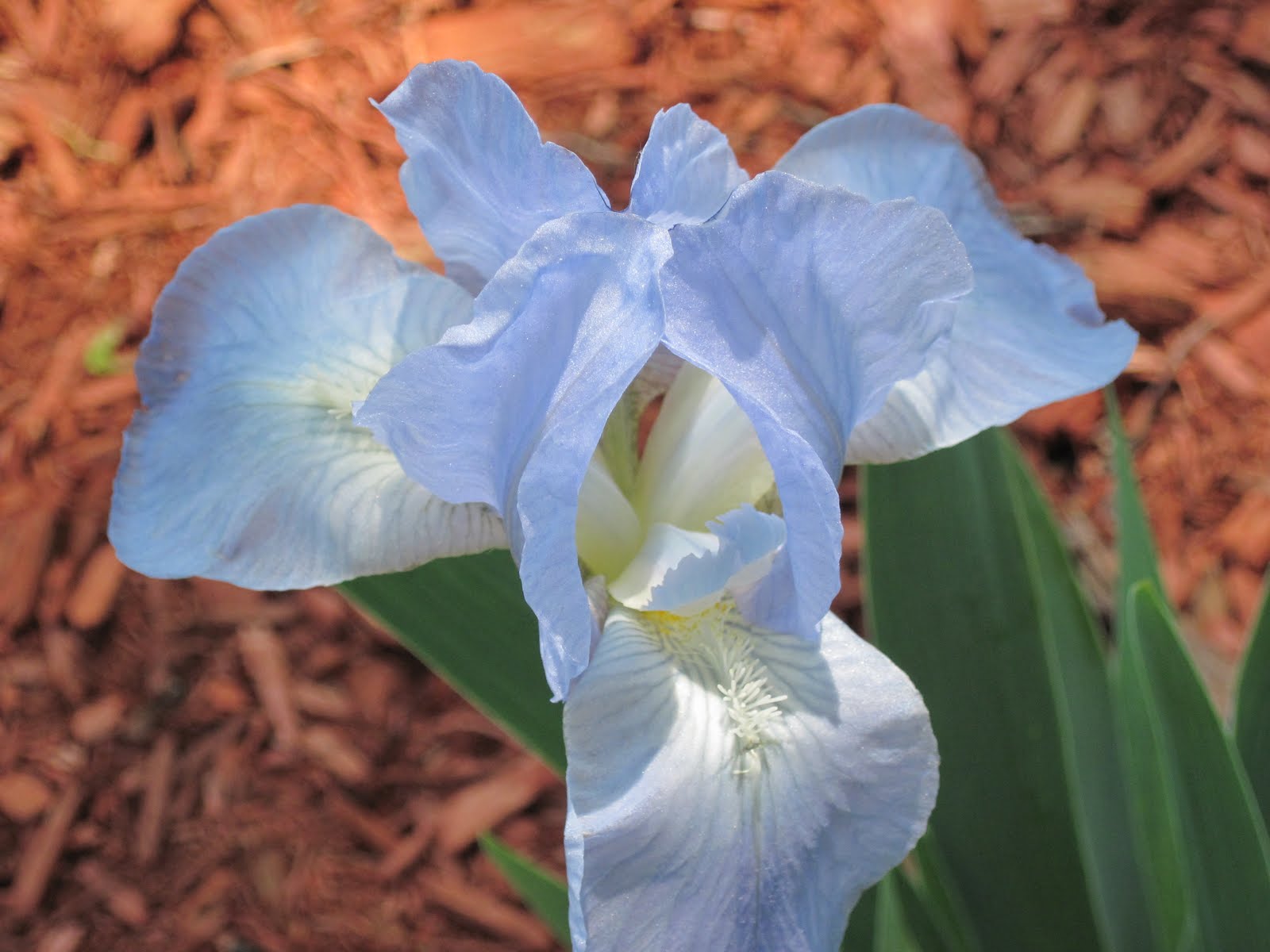

Some type of pale blue iris - as you may have noticed, I'm not good at remembering the names of different varieties or cultivars! All I know is that I got this at a local garden club sale, and that it is a short variety, with the the flowers no more than 6-8 inches above the ground and the leaves not much taller.


A closeup of the flowers of an azalea or dwarf rhododendron (I can't remember which) in front of the house. Notice the bee at work gathering nectar from the flower in the center - I believe this is a honey bee.

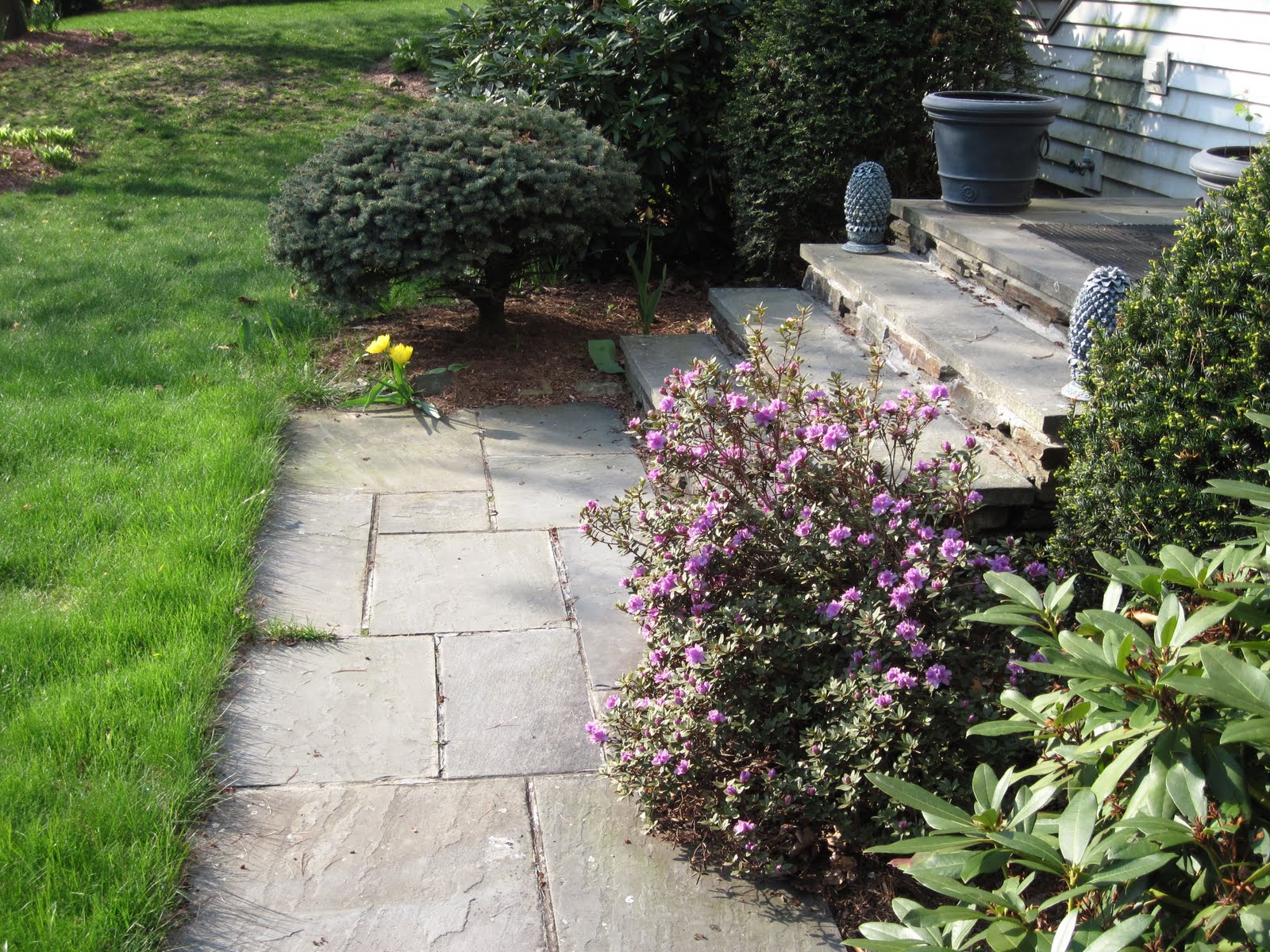
A broader view of the same azalea along the walkway to the front door of Dad's house (the house where I spent most of my childhood and have lived for some of my adult years as well.)


A cluster of pink tulips, with some white and red tulips in front of them (kind of washed out from the late afternoon sunlight glaring off the white flowers). The pale blue irises are at upper left, further from the camera than the tulips - you can see how they are pretty short.


An azalea bush with reddish flowers to the left, pink and mixed pink and white tulips to the right. There are a mix of lower-growing plants, including a few blue anemones to the left, a few purplish grape hyacinths to the right, the plant with the gray-colored foliage whose name I can never remember, and a bunch of lily-of-the valley sprouting just about everywhere it can. (Lily of the Valley spreads itself all too well by underground runners. Mom planted it years ago against her better judgment in a location a few feet to the left of the left edge of this photo, and surrounded it with a plastic barrier 6 inches deep to prevent it from spreading as recommended in the garden books. This worked for 2 or 3 years, but then its underground runners found some little breach and it has been spreading to a wider part of the garden each year.)


A patriotic grouping of flowers - red azalea bush, white candytuft (Iberis sempervirens), and blue anemones.


A nice ensemble photo, with 5 colors of tulip (multiple pinks and purples, 2 white with a little red, and a single solid red and single pale-pink/yellow) growing along with bleeding hearts (background), candytuft (lower left), and yellow alyssum (right). An azalea bush is just above the alyssum, but this one has not started to flower yet.


Pink, purple, and red tulips again, along with bleeding hearts and alyssum, and the pale blue irises (which were hidden behind another some of the tulips in the previous picture.)

Sunday, May 2, 2010

Garden: Least Wanted #1, Poison Ivy

Weeds are something that every gardener has to deal with. My own attitude toward weeds is not as always as hostile as that of the typical gardener. My mom, from whom I learned a lot of what I know about gardening, preferred a garden style that was somewhere between strictly formal, with no plants tolerated out of place, and natural or wildflower, where everything except the most noxious weeds are allowed to grow naturally. Her view tended to be that wildflowers and natural offspring of deliberately cultivated plants were welcome as long as 1) they didn't grow too big or crowd or choke out nearby plants, 2) they didn't look too unattractive or out of place - obviously a subjective judgment, but most garden choices have to be subjective. Taking care of the same garden for my father later, I followed a somewhat similar pattern, except that I err more on the side of giving things a chance to grow. Sometimes this "erring" is costly. Dad mildly but firmly informs me that I need to get more ruthless rather than waiting until halfway through summer to see if those unidentified seedlings of April will turn out to be nice wildflowers, only to discover that they are fast-growing weeds with microscopic flowers that are threatening to devour whole flower beds by the end of June - by which point they have developed clumps of thick roots the size of carrots and need a considerable amount of effort to be removed without tearing out 3 or 4 surrounding plants with them.

In spite of my far too indulgent attitude toward many plants that turn out to be weeds, there are a very few weeds that even I loathe enough to want to eliminate on sight. At the very top of the list is Toxicodendron radicans, better known as poison ivy, the little three-leaved plant growing out of the cracks of the stone wall just beneath a branch from an evergreen shrub here:

It's also known as Rhus radicans, or "The three-leaved spawn of Satan",
though the latter term might just be mine.

This plant is unfortunately familiar to many, perhaps most, people living in the eastern half of the United States and Canada. It's actually not a bad plant in many respects - it is a native plant, its foliage looks reasonably attractive, its berries are eaten by several different species of birds, and it even gets nice red foliage before dropping its leaves in autumn. It has just one slight flaw from a human perspective - all parts of the plant are covered by an oily chemical called urushiol that causes a severe itching and burning rash in the majority of people. Any physical contact between human skin and any part of the plant causes, for most people, anything from a slightly itchy rash to severe swelling and blistering that resembles a fairly serious burn. Some people have no reaction as children, but develop the allergy as adults. Unlike some toxins, the body actually tends to become more sensitive to the oil the more times it is exposed to it. The oil is potent enough that touching objects that have touched the plant, such as clothing and tools, is usually enough to cause a reaction. The WORST thing to do is burn the plant, because this simply vaporizes the oil and can cause severe irritation inside the nasal passages and lungs if one inhales the vapors.

Granted, poison ivy is far from the only plant that can cause a severe and painful reaction for people who simply touch it. Quite a few plants have urushiol - in the United States alone, there are two species of Poison oak and one of Poison sumac that cause similar, or sometimes even more severe effects. Some tropical regions have a number of plants that cause much more severe reactions than poison ivy or its relatives. Different people have different levels of both sensitivity and severity of reaction.

Still, in the northeastern United States, these other plants are non-existent or rare, while poison ivy grows abundantly and lushly in exactly the kind of places where people are likely to encounter it - in gardens, along the edges of yards, along sidewalks and streets, up the sides of trees and shrubs. It's a plant that thrives along the edges of land disturbed by human activity, and therefore many more people will literally come into contact with it than would be the case for a plant that grows mainly in deep woods or swamps. Many of these people will have a reaction that will range from merely irritating to quite painful and even debilitating (though temporary).

Poison ivy usually grows as a vine, either growing up trees, shrubs, rocks, fences, and buildings, or spreading along the ground. Sometimes it will grow more like a shrub. Its most characteristic feature is the leaves in clusters of three, with the middle leaf extended on a petiole (leaf-stalk) while the leaves on either side have little or no leaf-stalk. The leaves typically have a "shiny" and oily appearance, and they are often have a dark reddish hue when they are first emerging:
Growing along the ground with newest growth at upper right.

The stems or vines of poison ivy have just as much oil as the leaves. They are characterized by a distinctly "hairy" appearance when they climb up objects, especially as they get older and thicker:
"Hairy" poison ivy vine growing up chain link fence among other types of vine.
Note the reddish leaves emerging from the upper portions - this was a couple of weeks ago.

Unfortunately the "hairiness" is not nearly as obvious on young vines, and poison ivy also grows along the ground and as a shrub - in which case the stems often have no root hairs at all, since the hairs are used to cling on the objects to support the plant's growth upward.

1 year old stem with some root hairs, but mostly smooth.


There are several other plants that can be confused with poison ivy, especially if you are as paranoid about it as I am.

For example, there's Virginia creeper:

It has five rather than three leaves, but when the plant is growing three leaves sometimes emerge before the other two, making it look very similar to poison ivy. It's not related to poison ivy at all - it's actually a pretty close relative of grapes. In spite of a certain vague resemblance of leaf shape, it is not related to another well-known plant. It's not safe for everyone - it actually produces a different chemical that can cause bad allergic reactions in some people, but for a smaller percentage of the population than poison ivy. I've never had a bad reaction after years of weeding it with bare hands, and I'm really hoping that it stays that way.


Virginia creeper leaves have a similar oily shine to those of poison ivy, and the two plants are both vines that often grow right alongside each other. Below is part of the stone wall between the proper garden and the weed-rich waste area behind it. Poison ivy is growing over the stones toward the left, Virginia creeper toward the right. One branch of the poison ivy extends toward the right and is intermixed with the Virginia creeper. This gives some idea of how one could mix the two up if one is not constantly paying close attention.


Even the bare stems look similar. Compare the Virginia bare creeper vine below with the bare Poison ivy vine earlier in this post.


Another one that can be confused with poison ivy is a very young hickory sapling, which has leaves which are reddish and a little oily looking when they are newly grown. The hickory leaves grow in groups of five, like Virginia creeper, but it's easy to miss the extra two leaves if you aren't looking closely. Unlike poison ivy, hickory tree leaves have fine "teeth" all around the edges, and have a different overall shape:


There are also several types of wild berries, such as blackberries, raspberries, and strawberries, that grow their leaves in groups of three and can look similar to poison ivy. Their leaves tend to have more "teeth" around the edge, though.


So, Poison ivy is my personal most hated weed. When it comes the natural ecosystem as a whole, though, there are plenty that are worse ....

Tuesday, April 27, 2010

Garden views and greenery

Should this thing be called "Offhand comments from a frustrated gardener"? Sorry if I'm posting too much about the garden, but springtime sometimes gets me thinking about gardening and plants and botany in both practical and abstract ways.

Now, more garden pictures. These are two views from similar angles taken about 2 weeks apart, showing the relatively rapid growth and "greening" at this time of year:


Here you can see, among other plants, some of the hostas unfolding their leaves, and the Ostrich fern uncoiling its fronds. (The Ostrich fern was planted in a single spot 5 years ago. It's a "colony plant" that spreads through underground runners, and each year appears in one or two places where it didn't the year before.)


Another flower bed - this one has, among other plants, irisis, astilbe, peonies, spirea, echinacea (purple coneflowers), onions, daisies, rose campion, poppies, and sedum. Hardly any of these plants flower really early in the growing season, so it will be another 3 weeks to a month before this part of the garden starts to break out in lots of color. (The only things flowering here are a single pink hyacinth on the left, and a few pale blue phlox above and a little to the right of the hyacinth.)

Back to a part of the garden that has more early spring flowering action going on - Dicentra spectabilis bleeding hearts in full bloom, along with two different varieties of tulip:


In this next picture, the low lying blue flowers are anemones, which have already been flowering for almost 3 weeks. Above them, an azalea bush is about to start bursting out lots of bright magenta-pink flowers, while at the bottom the white candytuft (Iberis sempervirens) is also starting to flower. Little green sprouts of lily-of-the-valley are coming up around everything, and to the right that the ground is carpeted by the aptly named "grey-leafed, self-spreading plant whose name I can never remember"

There's always a major hazard when you don't put any kind of edging material between a garden bed and the lawn. Most lawn grasses will happily spread into the garden, especially because the mulched, composted, fertilized soil in the garden is probably more fertile than the soil under the lawn itself. If you have a low-growing groundcover plant at the edge of the flower bed, it's almost impossible to pull the spreading grass out without ripping out the plant you want to keep. What you can end up with is this:
in which the grass has pretty much taken over a chunk of what used to be part of the flower garden, and the actual garden plant (whose name, again, I can't remember - you can see bits of its greyish foliage peeking through the grass) is gradually being crowded out and choked by the faster-growing grass. I can only see two options - dig up everything and replant, or concede that this area is now part of the lawn again and start mowing it as part of the lawn, which will quickly finish off the last bits of the other plant.


Grass tends to spread more aggressively than most of my garden plants, but occasionally there is a problem going the other way. For example, here the Ostrich fern and a lamium with nice pink flowers both demonstrate a total lack of concern for my arbitrary boundary between flower garden and lawn:

The back of the yard, with the "waste area" between the stone wall and a fence. This has always been a very convenient place to dump clippings, weeds, small fallen branches, etc, and has saved countless trips to a landfill with yard waste over the years. After almost 3 decades of being dumped on like this, the soil is incredibly fertile in this strip - both weeds and "overflow" plants transplanted from the flower beds grow at least as well in the "waste area" as in the formal parts of the garden. Unfortunately, invasive Oriental Bittersweet and native but most unwelcome poison ivy are always creeping in from the other side of the chain-link fence, where I can never get rid of them. Cutting them and other weeds back is a necessary chore at least once or twice per growing season, and preferably more. Without cutting much of the this area would become a tangled mass of weeds in 1 year, and all of it in less than two.

Finally, bushes and a couple of tulips along the front walkway. Oddly, the front yard has far fewer flowering perennials than the back and side yards, partly because it's smaller, partly because much of the available space is taken up by shrubs and small trees instead.


Sunday, April 25, 2010

Garden flowers


The garden that I act as "caretaker" has mainly perennials. This makes it lower maintenance than a garden that has to be largely replanted each year, but it risks becoming monotonous. Fortunately, there are enough different types of flowers to keep it colorful and varied throughout the majority of the growing season.

The first flowers in the garden every spring are the crocuses.


Crocuses usually come up in late March or early April here. They will push up through snow if there is still some on the ground. Since this spring got mild earlier than usual, they came up in the middle of March with no trace of snow to impede them. The flowers are unfortunately short-lived - after about a week they start looking kind of worn out and soon start dropping petals, and are pretty much gone less than three weeks after opening.

The second flowers to start opening are usually the anemones.
This plant usually continues producing new flowers until June or later.


Soon, the hyacinths make a dramatic appearance, with a whole clump of flowers opening simultaneously on a stalk rising from each plant.
The lawn grass is has been pushing into this flower bed for the last couple of years,
but the hyacinths don't seem to be bothered.

Hyacinths usually flower mid-April, but this spring they came up in early April, and the flowers are already fading in color and on their way out for the year.


The daffodils often are the very first plants to poke leaves out of the ground, before even the crocus. Unlike the crocus, though, they usually take a little while (maybe 3-4 weeks) after first rising from the ground to open their flowers.
A pleasant surprise - this group had only pure lemon-yellow flowers last year,
but this year one of the flowers has two distinct colors.

Some of the daffodils are shriveling already, while others probably have another month left. They seem to vary widely in terms of how long their flowers last.


Then, there are the tulips. I am seeing most of them for the first time in 3 years, because in the previous 2 springs they almost all got eaten by deer. The lot does not border directly on a wooded area - it's several hundred feet from the edge of the nearest woods - so the deer liked the tulips enough to walk through several peoples' yards at night to get a special treat. In some cases they ate the plant down to near ground level, but in other cases they waited until the flower was just about to open, and then ate just the flower and stem, which must be like the finest piece of chocolate to them. Finding these "decapitated" tulips was especially annoying.

This year, though, the deer haven't touched anything. Maybe the early spring meant more plants sprouting earlier in the forests so less need to forage in peoples' gardens. In any case, the tulips got a chance to flower again:
The pink and white striped ones in the middle photo were another pleasant surprise - I'm pretty sure that they were solid pink the last time they got a chance to flower. The stripes of various colors and patterns have an interesting history. These markings were especially prized by European tulip growers back in the 17th century. For a few years in the 1630s, breeding tulips became so lucrative in the Netherlands that tulip bulbs became a major investment vehicle, with single bulbs that produced flowers with unusual color combinations and patterns selling for the equivalent of several million dollars. This "tulipmania" collapsed, but tulips remained among the more prized flowers for the wealthy into the 19th century, when they finally became affordable to a larger public. Many attempts were made to crossbreed plants for seeds with more elaborate colors and patterns, but these almost always failed. Unbeknownst to early tulip-breeders, the stripes and multiple colors are not hereditary. They are caused by a viral infection that usually does not have any serious negative effect on the plant's health except to discolor the flowers. That's why a plant can go from solid-color flowers one year to striped and multicolored flowers the next year - it has been infected at some point. The fact that these diseased flowers happened to look more attractive to some people was just a lucky coincidence. Tulip growers discovered that the only way to reproduce a tulip with a desirable color and pattern was to wait for the main bulb to reproduce asexually by budding off smaller bulbs, and then separating these extra bulbs and replanting them. A tulip bulb in good soil will usually produce a number of clones in this fashion, so that rather than seeds became the main technique of tulip propagation.

Anyway, moving on from that hopefully not too dull mini-lecture, here is one of the next flowers to bloom, Dicentra spectabilis, the Bleeding heart:
Flowers slightly less than 1 inch (~2 cm.) from top to bottom.

Dicentra spectabilis is native to eastern Asia. It grows 2-3 feet tall and produces rows of fairly large, colorful, unusually shaped flowers by mid to late April. Unfortunately, as is the case with so many colorful perennials, the flowers have a limited life span. In less than a month, the flowers have mostly dropped. By late June, the plant's leaves and stems start to wilt and yellow in the summer heat, and by July I cut them back to the ground because the entire plant has turned a dead-looking yellow-brown. Ideally, a gardener should plant something that flowers later in the season alongside the bleeding heart so that something can take the plant's space in the garden when it dies back. I've tried a couple of things, but they haven't lasted more than a season.

In another part of the garden, there is a close relative of the bleeding-heart. This is Dicentra eximia. The garden has plants with both white and pink flowers. Dicentra eximia is a native of eastern North America (unlike most of the other plants in this post, which originate in various parts of Asia or Europe). It is only about 1 foot tall, and the flowers are proportionally smaller than those of Dicentra spectabilis, so it is much less showy. However, it has one major advantage - it stays green and keeps blooming throughout the entire growing season. It produces flowers from April through October, although there tend to be fewer later in the season.

Finally, some yellow Alyssum next to the front walkway. This plant is quite good at reseeding itself - it was originally planted in the garden some 20 years ago, and has grown in various parts of most of the different flower beds over time. It's a perennial, but the individual plants often die after a few years, to be replaced by their "children" growing nearby. The alyssum looks all but surrounded by various shrubs and trees, including the weeping cherry in the background.


Next - greenery and general views of the garden ....

Friday, April 23, 2010

Springtime pics

On a brighter note, the last two weeks have been extraordinarily colorful. Here are some pics from my Dad's yard/garden, which I basically act as a caretaker for. First, the trees. The weeping cherry peaked almost two weeks ago, when I took these photos:


Weeping cherry from two angles.


From underneath


Closeup of flowers


The other "tree" flowering now is a magnolia, but it is really more like a shrub.

Earlier this week, taken at the bottom of a slope -
it's actually barely taller than I am. Note the fading weeping cherry in the background.

Closeup of magnolia flowers.


These two trees are artificially bred varieties. There is at least one type of "wild" tree in the yard that puts on a nice display of flowering color - the red maple (Acer rubrum). Unlike most maples which rely entirely on wind to spread their pollen, the red maple uses the services of insects as well as the wind. Therefore, it produces colorful (though small) red flowers.

Red maple flowers almost 4 weeks ago.

Thousands of these small red flowers give the whole tree a distinct reddish tint that sets it apart from all other tree species in the area in the spring.

This sort of shows the reddish tint.

Red maples don't wait long after flowering to make their seeds. While other maples take until summer or fall to mature their seeds, the red maples have developed their seeds over the last 3 weeks or so, and will be ready to start dropping them all over the place come May.

The leaves are just coming out, but the seeds are almost mature.

As the red maples go through their accelerated flowering, seed development, and leafing out, the sugar maple (Acer saccharum) right next to them has barely started to poke either its leaves or flowers out. It won't drop its seeds until late summer or early fall. Still, time is ultimately on the side of the sugar maple, which on average grows taller and lives more than twice as long as the red maple.


Right: red maple; Left: sugar maple (ignore the pine behind it)

The sugar maple is the leading source of maple sugar (Duh!),
but you can get it from red maples as well - you just need a lot more sap
to get the same amount of sugar.

Next - Crocus, daffodils, tulips, and hyacinths; or, early spring flowers that aren't attached to trees and shrubs.

Wednesday, April 21, 2010

Down time (explanation and apology)

I've been having a lot of down time lately. I'm not referring to the kind of down time where I kick back and relax. I'm referring to the kind of down time where the psychological illness that I've been struggling with all my life rears up especially strong and makes me doubt my fitness to exist in human society.

One sign that I'm going through a relatively rough time is that my ability to communicate effectively with other human beings (both in person and electronically) drops further - and I'm not exactly a master communicator even at the best of times. When I do "communicate" with people online at times like these, it's often to argue and contradict. So, I end up doing what I did here - that is, getting into an argument for the sake of getting into an argument. I must apologize for that. I still don't entirely agree with the people that I was arguing with, but I overstated my case just to irritate people, which is the kind of thing that I should have stopped doing quite a few years ago when I became an adult.

I should have posted this days ago, but writing about this even briefly is not an easy thing for me to do, and I unfortunately treated it like I treat a lot of emotionally unpleasant things - I avoid and procrastinate as long as possible.