Tuesday, April 27, 2010

Garden views and greenery

Should this thing be called "Offhand comments from a frustrated gardener"? Sorry if I'm posting too much about the garden, but springtime sometimes gets me thinking about gardening and plants and botany in both practical and abstract ways.

Now, more garden pictures. These are two views from similar angles taken about 2 weeks apart, showing the relatively rapid growth and "greening" at this time of year:


Here you can see, among other plants, some of the hostas unfolding their leaves, and the Ostrich fern uncoiling its fronds. (The Ostrich fern was planted in a single spot 5 years ago. It's a "colony plant" that spreads through underground runners, and each year appears in one or two places where it didn't the year before.)


Another flower bed - this one has, among other plants, irisis, astilbe, peonies, spirea, echinacea (purple coneflowers), onions, daisies, rose campion, poppies, and sedum. Hardly any of these plants flower really early in the growing season, so it will be another 3 weeks to a month before this part of the garden starts to break out in lots of color. (The only things flowering here are a single pink hyacinth on the left, and a few pale blue phlox above and a little to the right of the hyacinth.)

Back to a part of the garden that has more early spring flowering action going on - Dicentra spectabilis bleeding hearts in full bloom, along with two different varieties of tulip:


In this next picture, the low lying blue flowers are anemones, which have already been flowering for almost 3 weeks. Above them, an azalea bush is about to start bursting out lots of bright magenta-pink flowers, while at the bottom the white candytuft (Iberis sempervirens) is also starting to flower. Little green sprouts of lily-of-the-valley are coming up around everything, and to the right that the ground is carpeted by the aptly named "grey-leafed, self-spreading plant whose name I can never remember"

There's always a major hazard when you don't put any kind of edging material between a garden bed and the lawn. Most lawn grasses will happily spread into the garden, especially because the mulched, composted, fertilized soil in the garden is probably more fertile than the soil under the lawn itself. If you have a low-growing groundcover plant at the edge of the flower bed, it's almost impossible to pull the spreading grass out without ripping out the plant you want to keep. What you can end up with is this:
in which the grass has pretty much taken over a chunk of what used to be part of the flower garden, and the actual garden plant (whose name, again, I can't remember - you can see bits of its greyish foliage peeking through the grass) is gradually being crowded out and choked by the faster-growing grass. I can only see two options - dig up everything and replant, or concede that this area is now part of the lawn again and start mowing it as part of the lawn, which will quickly finish off the last bits of the other plant.


Grass tends to spread more aggressively than most of my garden plants, but occasionally there is a problem going the other way. For example, here the Ostrich fern and a lamium with nice pink flowers both demonstrate a total lack of concern for my arbitrary boundary between flower garden and lawn:

The back of the yard, with the "waste area" between the stone wall and a fence. This has always been a very convenient place to dump clippings, weeds, small fallen branches, etc, and has saved countless trips to a landfill with yard waste over the years. After almost 3 decades of being dumped on like this, the soil is incredibly fertile in this strip - both weeds and "overflow" plants transplanted from the flower beds grow at least as well in the "waste area" as in the formal parts of the garden. Unfortunately, invasive Oriental Bittersweet and native but most unwelcome poison ivy are always creeping in from the other side of the chain-link fence, where I can never get rid of them. Cutting them and other weeds back is a necessary chore at least once or twice per growing season, and preferably more. Without cutting much of the this area would become a tangled mass of weeds in 1 year, and all of it in less than two.

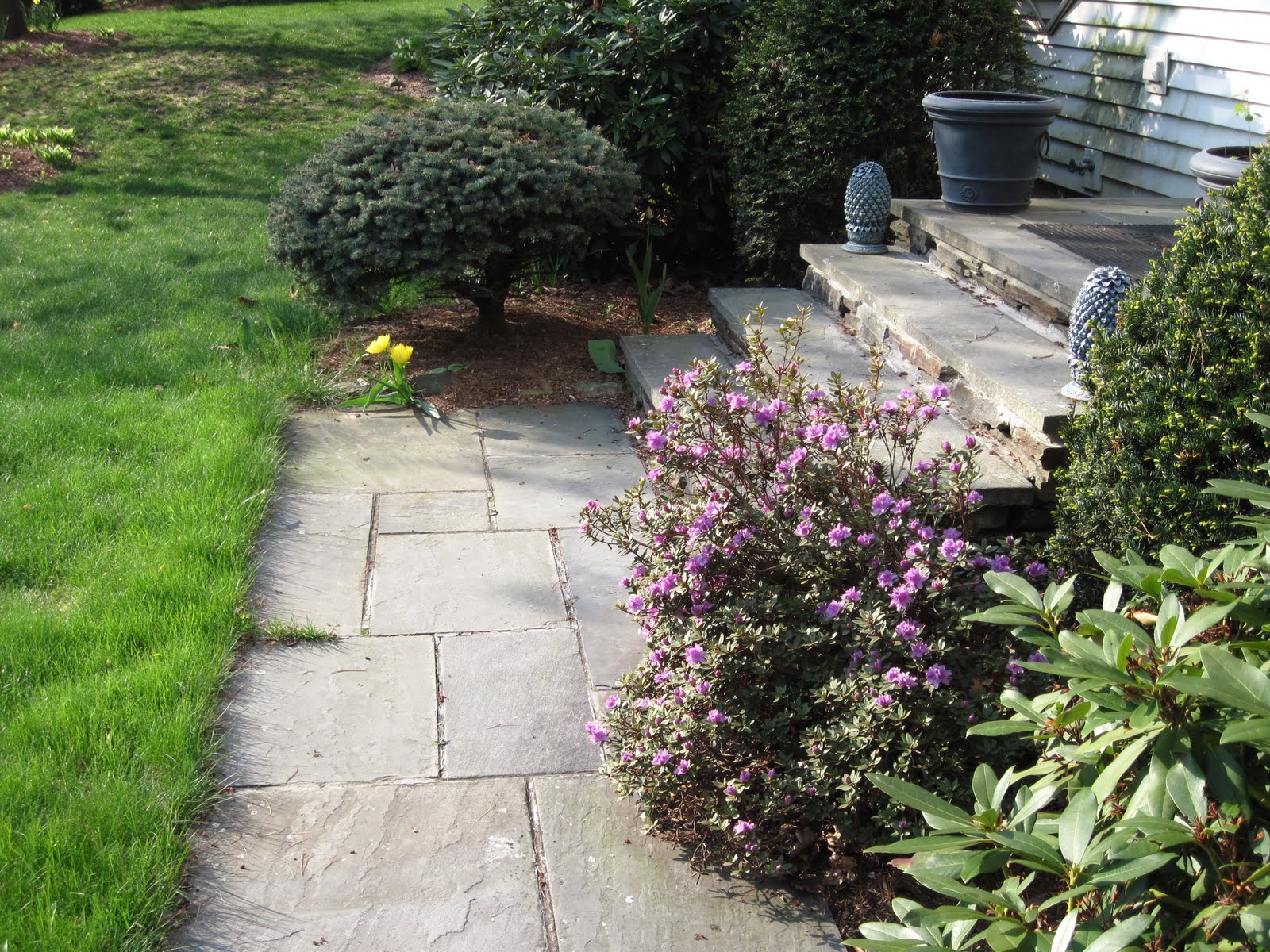
Finally, bushes and a couple of tulips along the front walkway. Oddly, the front yard has far fewer flowering perennials than the back and side yards, partly because it's smaller, partly because much of the available space is taken up by shrubs and small trees instead.


Sunday, April 25, 2010

Garden flowers


The garden that I act as "caretaker" has mainly perennials. This makes it lower maintenance than a garden that has to be largely replanted each year, but it risks becoming monotonous. Fortunately, there are enough different types of flowers to keep it colorful and varied throughout the majority of the growing season.

The first flowers in the garden every spring are the crocuses.


Crocuses usually come up in late March or early April here. They will push up through snow if there is still some on the ground. Since this spring got mild earlier than usual, they came up in the middle of March with no trace of snow to impede them. The flowers are unfortunately short-lived - after about a week they start looking kind of worn out and soon start dropping petals, and are pretty much gone less than three weeks after opening.

The second flowers to start opening are usually the anemones.
This plant usually continues producing new flowers until June or later.


Soon, the hyacinths make a dramatic appearance, with a whole clump of flowers opening simultaneously on a stalk rising from each plant.
The lawn grass is has been pushing into this flower bed for the last couple of years,
but the hyacinths don't seem to be bothered.

Hyacinths usually flower mid-April, but this spring they came up in early April, and the flowers are already fading in color and on their way out for the year.


The daffodils often are the very first plants to poke leaves out of the ground, before even the crocus. Unlike the crocus, though, they usually take a little while (maybe 3-4 weeks) after first rising from the ground to open their flowers.
A pleasant surprise - this group had only pure lemon-yellow flowers last year,
but this year one of the flowers has two distinct colors.

Some of the daffodils are shriveling already, while others probably have another month left. They seem to vary widely in terms of how long their flowers last.


Then, there are the tulips. I am seeing most of them for the first time in 3 years, because in the previous 2 springs they almost all got eaten by deer. The lot does not border directly on a wooded area - it's several hundred feet from the edge of the nearest woods - so the deer liked the tulips enough to walk through several peoples' yards at night to get a special treat. In some cases they ate the plant down to near ground level, but in other cases they waited until the flower was just about to open, and then ate just the flower and stem, which must be like the finest piece of chocolate to them. Finding these "decapitated" tulips was especially annoying.

This year, though, the deer haven't touched anything. Maybe the early spring meant more plants sprouting earlier in the forests so less need to forage in peoples' gardens. In any case, the tulips got a chance to flower again:
The pink and white striped ones in the middle photo were another pleasant surprise - I'm pretty sure that they were solid pink the last time they got a chance to flower. The stripes of various colors and patterns have an interesting history. These markings were especially prized by European tulip growers back in the 17th century. For a few years in the 1630s, breeding tulips became so lucrative in the Netherlands that tulip bulbs became a major investment vehicle, with single bulbs that produced flowers with unusual color combinations and patterns selling for the equivalent of several million dollars. This "tulipmania" collapsed, but tulips remained among the more prized flowers for the wealthy into the 19th century, when they finally became affordable to a larger public. Many attempts were made to crossbreed plants for seeds with more elaborate colors and patterns, but these almost always failed. Unbeknownst to early tulip-breeders, the stripes and multiple colors are not hereditary. They are caused by a viral infection that usually does not have any serious negative effect on the plant's health except to discolor the flowers. That's why a plant can go from solid-color flowers one year to striped and multicolored flowers the next year - it has been infected at some point. The fact that these diseased flowers happened to look more attractive to some people was just a lucky coincidence. Tulip growers discovered that the only way to reproduce a tulip with a desirable color and pattern was to wait for the main bulb to reproduce asexually by budding off smaller bulbs, and then separating these extra bulbs and replanting them. A tulip bulb in good soil will usually produce a number of clones in this fashion, so that rather than seeds became the main technique of tulip propagation.

Anyway, moving on from that hopefully not too dull mini-lecture, here is one of the next flowers to bloom, Dicentra spectabilis, the Bleeding heart:
Flowers slightly less than 1 inch (~2 cm.) from top to bottom.

Dicentra spectabilis is native to eastern Asia. It grows 2-3 feet tall and produces rows of fairly large, colorful, unusually shaped flowers by mid to late April. Unfortunately, as is the case with so many colorful perennials, the flowers have a limited life span. In less than a month, the flowers have mostly dropped. By late June, the plant's leaves and stems start to wilt and yellow in the summer heat, and by July I cut them back to the ground because the entire plant has turned a dead-looking yellow-brown. Ideally, a gardener should plant something that flowers later in the season alongside the bleeding heart so that something can take the plant's space in the garden when it dies back. I've tried a couple of things, but they haven't lasted more than a season.

In another part of the garden, there is a close relative of the bleeding-heart. This is Dicentra eximia. The garden has plants with both white and pink flowers. Dicentra eximia is a native of eastern North America (unlike most of the other plants in this post, which originate in various parts of Asia or Europe). It is only about 1 foot tall, and the flowers are proportionally smaller than those of Dicentra spectabilis, so it is much less showy. However, it has one major advantage - it stays green and keeps blooming throughout the entire growing season. It produces flowers from April through October, although there tend to be fewer later in the season.

Finally, some yellow Alyssum next to the front walkway. This plant is quite good at reseeding itself - it was originally planted in the garden some 20 years ago, and has grown in various parts of most of the different flower beds over time. It's a perennial, but the individual plants often die after a few years, to be replaced by their "children" growing nearby. The alyssum looks all but surrounded by various shrubs and trees, including the weeping cherry in the background.


Next - greenery and general views of the garden ....

Friday, April 23, 2010

Springtime pics

On a brighter note, the last two weeks have been extraordinarily colorful. Here are some pics from my Dad's yard/garden, which I basically act as a caretaker for. First, the trees. The weeping cherry peaked almost two weeks ago, when I took these photos:


Weeping cherry from two angles.


From underneath


Closeup of flowers


The other "tree" flowering now is a magnolia, but it is really more like a shrub.

Earlier this week, taken at the bottom of a slope -
it's actually barely taller than I am. Note the fading weeping cherry in the background.

Closeup of magnolia flowers.


These two trees are artificially bred varieties. There is at least one type of "wild" tree in the yard that puts on a nice display of flowering color - the red maple (Acer rubrum). Unlike most maples which rely entirely on wind to spread their pollen, the red maple uses the services of insects as well as the wind. Therefore, it produces colorful (though small) red flowers.

Red maple flowers almost 4 weeks ago.

Thousands of these small red flowers give the whole tree a distinct reddish tint that sets it apart from all other tree species in the area in the spring.

This sort of shows the reddish tint.

Red maples don't wait long after flowering to make their seeds. While other maples take until summer or fall to mature their seeds, the red maples have developed their seeds over the last 3 weeks or so, and will be ready to start dropping them all over the place come May.

The leaves are just coming out, but the seeds are almost mature.

As the red maples go through their accelerated flowering, seed development, and leafing out, the sugar maple (Acer saccharum) right next to them has barely started to poke either its leaves or flowers out. It won't drop its seeds until late summer or early fall. Still, time is ultimately on the side of the sugar maple, which on average grows taller and lives more than twice as long as the red maple.


Right: red maple; Left: sugar maple (ignore the pine behind it)

The sugar maple is the leading source of maple sugar (Duh!),
but you can get it from red maples as well - you just need a lot more sap
to get the same amount of sugar.

Next - Crocus, daffodils, tulips, and hyacinths; or, early spring flowers that aren't attached to trees and shrubs.

Wednesday, April 21, 2010

Down time (explanation and apology)

I've been having a lot of down time lately. I'm not referring to the kind of down time where I kick back and relax. I'm referring to the kind of down time where the psychological illness that I've been struggling with all my life rears up especially strong and makes me doubt my fitness to exist in human society.

One sign that I'm going through a relatively rough time is that my ability to communicate effectively with other human beings (both in person and electronically) drops further - and I'm not exactly a master communicator even at the best of times. When I do "communicate" with people online at times like these, it's often to argue and contradict. So, I end up doing what I did here - that is, getting into an argument for the sake of getting into an argument. I must apologize for that. I still don't entirely agree with the people that I was arguing with, but I overstated my case just to irritate people, which is the kind of thing that I should have stopped doing quite a few years ago when I became an adult.

I should have posted this days ago, but writing about this even briefly is not an easy thing for me to do, and I unfortunately treated it like I treat a lot of emotionally unpleasant things - I avoid and procrastinate as long as possible.

Monday, April 5, 2010

First garden weekend

Easter is associated with resurrection and rebirth, and the weather here this past weekend could not have been more appropriate. After a period of record heavy rains that caused serious flooding in some areas earlier last week, everything changed in time for the weekend. The temperature was 70-75 Fahrenheit (21-24 Celsius) during the afternoon, abnormally warm this early in spring in these parts. There was barely a cloud in the sky either day, and the air was relatively dry with just enough breeze to cool the skin a little bit. So, it was obvious that I would have to spend much of both days doing garden maintenance in my father's garden (lacking any garden, or land, of my own at the moment).

I'm normally not much of a fan of hard physical work or chores, but working outside on a really nice day is much less burdensome, in my opinion, than vacuuming or cleaning bathrooms. There were three basic tasks to be accomplished this weekend - trimming and cutting back, raking out the various flower beds, and trying to rake over as much of the lawn as possible in order to pull out the matted dead grass blades from the winter (a.k.a. dethatching). I managed to accomplish all of them, not perfectly, but adequately, I think, and left a considerably cleaner garden ready for future steps, as well as a lawn that is at least a little less suffocated by a blanket of grass from last year.
Part of one of the flower beds early in the process of being cleaned out. The grass has been
reclaiming one corner for the last 2 or 3 years.


Part of the back yard. If you're used to a milder climate, you'll have to trust me when I say
that the grass here is incredibly lush and green for early April.


Most of the perennials and shrubs are off to an early start, and so are the trees. The red maples are usually just getting started, but this year their red flowers are just about at their peak.

Closeup of red maple (Acer rubrum) flowers.

I even managed to find a bird that would stay still long enough in one of the maples for me to get a decent picture - I think it's a red-winged blackbird, but you can't see the red patches on the wings because most of the light is coming from behind. Too bad I didn't notice that the bird's head was hidden - I'm not exactly what you would call a great photographer!

Agelaius phoenicius perched in Acer rubrum. Background provided by
a commercial jet of unknown model.

It's not easy to find a bird around here that isn't camera-shy. The only birds that I could get a really decent picture of were some american robins, and even they would only cooperate when I was inside and took the photos through a window.

The American Robin, or Turdus migratorius. Yes, that is the real
scientific name for the species. I can only guess that they showed up
really late when they were assigning names.

Although most things are really just getting started, much of the local ecology seems to be about 1-2 weeks ahead of schedule this spring. Apart from some crocus, daffodils, and the red maples, very little is blooming yet, but the weeping cherry out front is looking like it won't be long before it erupts in light pink blossoms.

Buds on weeping cherry.

All in all, a very good weekend for someone who likes spring and gardening!


Tuesday, March 23, 2010

Health Care

I have very mixed feelings about the whole health care issue, which is one reason why I've avoided the whole angry debate. On the one hand, I used to be a conservative with a libertarian streak, and still am sometimes, so massively expensive government social programs aren't normally something I instinctively welcome with open arms, to put it mildly. On the other hand, when peoples' lives are actually at stake, it seems cruel NOT to assist in any way possible. To me at least, human life and health are more important than almost any other consideration.

Still, I can't help but wonder how we (the USA) are going to pay for all of this when the government is already trillions of dollars in debt. This issue doesn't seem to have gotten nearly as much attention in the whole debate as it deserves. Health care for every citizen is an absolutely massive expense that the government is committing itself to supporting permanently.

I don't think that the examples of other countries are necessarily very helpful here. Don't get me wrong - I think that it's generally a good thing that people in pretty much every other developed country have government-provided healthcare. My brother, sister-in-law, and niece live in Germany (my sister in law is a German citizen, my niece has dual nationality), and one of the more important reasons that they chose to live there over the United States is because of the national healthcare coverage. The problem is that when it comes to funding, comparing the USA to any other developed country is an apples and oranges comparison, for a couple of reasons.

1. The USA has to support huge military expenses that other developed countries do not. Some people think that this is because the USA is an evil imperialist nation(TM). I tend to think that it's simply because other developed nations have pretty much thrown all of the military responsibility onto the USA.

2. The USA has a population that simply is less healthy to begin with, due to the lifestyles that many people lead. This isn't completely the fault of individual Americans - business and government in the USA made a long series of decisions over decades that favored turning the USA into a largely car-dependent, highly-processed-low-nutrition-food-eating nation. Now we have a couple of generations who have grown up knowing no other way of life, and we lack the infrastructure for good public transportation in many regions, and it will be extremely difficult to change. Unfortunately, this means that the population of the USA is likely to remain less healthy, with higher medical expenses, than those of most other developed nations well into the future. This means higher per capita medical costs compared to virtually every other country in the world.

Am I the only one who is nervous about taking on such a massive new expense when we already have a national debt that is larger than most people can even comprehend?

Sunday, March 21, 2010

Early taste of late spring

When I went outside Friday and yesterday, I had to remind myself repeatedly that this is the second half of March, not the second half of April or even the first half of May. The temperature was around 70 Fahrenheit (21 Celsius), which is quite a bit warmer than we would normally expect for March, which is a month where we can normally expect temperatures a good 15 or 20 degrees Fahrenheit (about 10 degrees Celsius) cooler. The preceding several days were not as warm, but still warmer than average.

Plants are clearly responding to this unusually early coming of warm springtime weather. Normally, I can expect to see crocus coming up at the very end of March or beginning of April, and the daffodils and tulips following shortly in early to mid April - though only the crocus blooms almost immediately after appearing. Yesterday, though:

Crocus - already blooming!


Tulips


Daffodils

And it isn't just the bulbs that seem are responding to the early warmth:

Some shrub - maybe some kind of honeysuckle?

The only snow I saw on a 3-mile walk was one pile of very dirty snow next to a school parking lot that had managed to hold out against over two weeks of rain and mainly above freezing temperatures:

Holdout snow pile, which is probably noticeably smaller today

Still, if you look really close at some of the trees in the background, you can see a slight tinge of red on some of them. That's a sign that they are red maples and that their first red flower buds are getting close to opening - probably some 2-3 weeks earlier than in an average year.

Now, what I'm really hoping for is that we don't get any long cold spells for the rest of the spring. Some plants can endure some real cold after they start growing leaves and flowers for the spring, others can't, and the latter will depend on the rest of the spring being free from serious cold spells.

I walked down a road that I haven't walked since last summer, and so from my point of view the plants weren't the only things that had seemingly appeared out of nowhere. A new building had risen from ground that supported only trees last year:

I could be wrong, but this building doesn't look like it will be particularly attractive
when finished. I'm not sure what it's going to be - the area around it is entirely residential, but it looks
more like a small office building to me.

Well, it's cooler today, but still pretty warm. By late in the week, it's supposed to be getting down to near freezing at night. Hopefully it won't stay much colder than that for an extended period of time. Also, even if the spring temperatures decide to act like this is Georgia or something - the summer temperatures had better not act like this is Georgia! Part of the bargain of living in a northern state, IMHO, is that you accept a colder and longer winter in return for not having to endure as long or as hot a summer.